
Turbo / VGT Actuator Diagnosis
Turbo Actuator Stuck
A stuck VGT actuator is one of the most common causes of low boost, derate, and limp-mode across global diesel fleets. This guide covers actuator position testing, sweep tests, and vane ring inspection for Cummins, Detroit, Paccar, Volvo, CAT, and International engines.
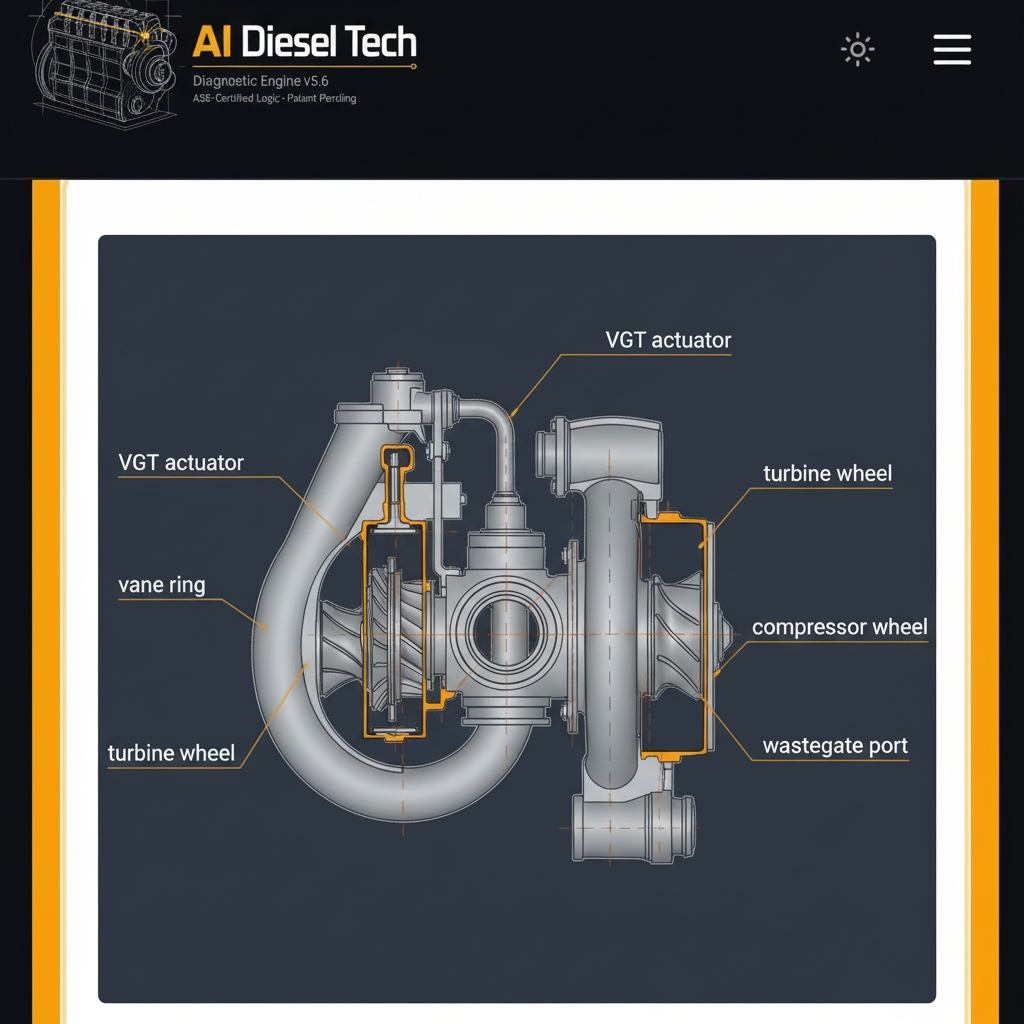
Why This Matters
- ▸ Low boost leads directly to low power and slow acceleration — don't blame injectors before testing the VGT.
- ▸ A stuck VGT causes failed regens and SCR efficiency problems that cascade into derate.
- ▸ Incorrect actuator position raises EGTs and can destroy turbo efficiency over time.
- ▸ Fleet downtime from turbo issues quickly increases cost per mile — diagnose fast.
8-Step Diagnostic Flow
Verify boost pressure under load
Compare actual boost pressure to desired (commanded) under load. A large delta with no other obvious cause points to VGT or turbo mechanical issues. Check at highway cruise and during acceleration.
Check VGT actuator position
SPN 641 (VGT actuator). Compare commanded vs actual position in live data. A mismatch of more than 5–10% at any point in the sweep indicates actuator failure, binding, or position sensor drift.
Run actuator sweep test
If supported by the OEM scan tool, command a full actuator sweep (0–100%). Watch for slow response, incomplete travel, or position dropout. A healthy actuator follows the command smoothly across the full range.
Inspect turbo for shaft play or binding
Excessive shaft play (radial or axial) indicates bearing wear. Binding in the vane ring can cause the actuator to stall even when electrically sound. Inspect the turbo before condemning the actuator.
Check turbo speed sensor correlation
SPN 1127 (turbo speed). If equipped, compare turbo RPM to expected values at given boost levels. A turbo that spins fast but builds no boost suggests a vane ring or actuator issue rather than a compressor problem.
Inspect exhaust side for soot buildup
Heavy soot buildup around the vane ring is a common cause of VGT sticking. Remove the exhaust outlet and inspect the vane ring for carbon deposits. Cleaning may restore function temporarily, but root cause (high soot production) must be addressed.
Inspect intake and charge air system for leaks
CAC leaks and intake restrictions can mimic low boost from a stuck actuator. Pressure test the charge air system before condemning the VGT. A leaking CAC will show low boost even with a fully functional turbo.
Check MAP/MAF correlation and EGR contribution
SPN 102 (MAP), SPN 132 (MAF). EGR flow affects intake charge and can mask turbo performance issues. Verify MAP and MAF readings are consistent with expected values before finalizing diagnosis.
Engine-Specific Notes
Cummins ISX / X15
Electronic actuator failures are common after high mileage. Watch for position mismatch codes (SPN 641 FMI 7) and slow response under load. Cummins recommends actuator replacement as an assembly — gear wear inside the unit is not serviceable in the field.
Detroit DD13 / DD15
VGT ring coking causes slow movement and low boost, especially in low-load or idle-heavy duty cycles. The actuator may pass basic electrical tests but fail under heat and load. Inspect the vane ring before replacing the actuator.
Paccar MX-13
Gear wear inside the actuator leads to position drift and intermittent low boost complaints. MX-13 actuator failures often present as a gradual loss of boost over time rather than a sudden failure. Position sensor drift is also common.
Volvo / Mack MP8
Turbo speed sensor correlation is critical for accurate diagnosis on Volvo platforms. CAC leaks frequently coexist with actuator complaints — always pressure test the charge air system before condemning the VGT actuator.
CAT C13 / C15
Soot buildup on the vane ring causes sticking under load, especially in vocational and construction applications. High EGTs and black smoke often accompany actuator issues. Inspect the vane ring and exhaust side before replacing the actuator.
International A26
Actuator overheating during long regens can cause intermittent failure. Watch for derate tied to turbo performance codes after extended regen cycles. Check actuator connector and harness for heat damage near the turbo housing.
DVOM Test Points
| Test | Spec | Note |
|---|---|---|
| VGT actuator motor resistance | 1.5–3.0 Ω (verify OEM spec) | Open circuit = no motor control; high resistance = restricted movement |
| Position sensor signal | 0.5–4.5 V sweep across full travel | Out-of-range or non-linear signal = sensor failure; check harness first |
| Turbo speed sensor | 1.0–2.5 V AC (inductive type) | No signal = sensor or wiring failure; verify gap and debris at tip |
| MAP sensor | 5 V reference, 0.5–4.5 V signal under load | Biased MAP causes incorrect boost calculation and VGT command errors |
Live Data Parameters to Monitor
Boost Pressure (psi/kPa)
Actual vs desired — large delta under load = VGT or turbo issue
VGT Position (% commanded vs % actual)
Should match within 5–10% — large mismatch = actuator failure
Turbo Speed (RPM)
Correlate with boost — high RPM, low boost = vane ring or CAC leak
MAP vs MAF Correlation
Should track together — divergence = intake leak or EGR issue
EGR Flow Contribution
Verify EGR is not masking turbo performance data
Exhaust Temps (pre/post turbo)
High pre-turbo EGTs with low boost = VGT not building backpressure
Related Fault Codes
Frequently Asked Questions
Can a stuck actuator alone cause a 5 MPH derate?
Yes. If the turbo cannot build boost, aftertreatment logic fails, SCR efficiency drops, and the ECM will eventually induce a severe derate. The derate is a downstream consequence of the turbo not providing adequate airflow for combustion and aftertreatment function.
Can I free a stuck actuator manually with a wrench?
No. Forcing the actuator can strip gears, damage the motor, and create a false "fixed" condition that fails again under load. Always follow OEM procedures for actuator testing and replacement.
Should I replace the turbo if the actuator is stuck?
Not always. Some platforms allow actuator replacement separately from the turbo assembly. Always follow OEM guidance and inspect vane ring condition before deciding. If the vane ring is heavily coated with carbon, cleaning or turbo replacement may be required.
Master Turbo & VGT Diagnosis
The AI Diesel Tech Academy covers VGT actuator testing, turbo speed sensor correlation, and boost system diagnostics with DVOM procedures and real-world case studies.
Explore the Academy