
EGR System Diagnosis
EGR System Problems
EGR system problems on your diesel truck? This guide covers EGR valve position testing, cooler flow, differential pressure sensors, and MAP/MAF verification for Cummins, Detroit, Paccar, Volvo, CAT, and International engines.
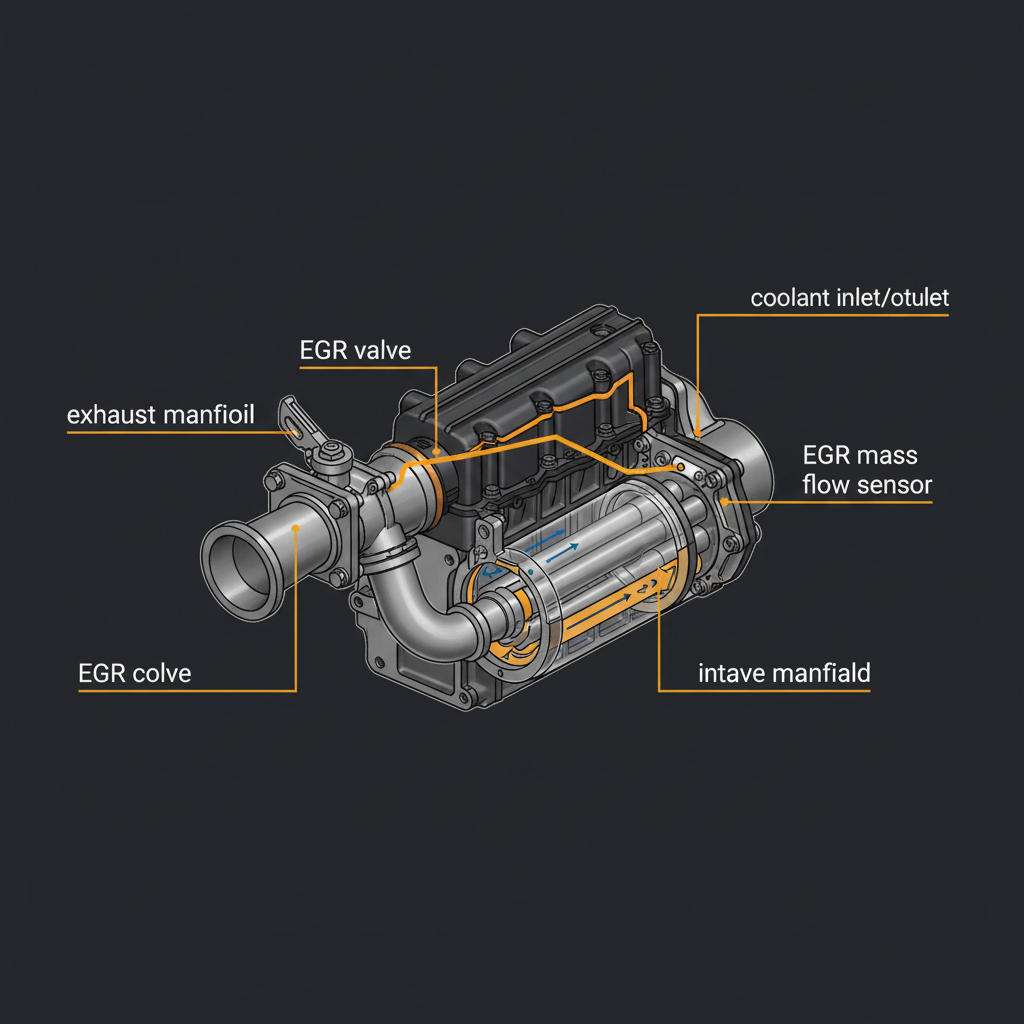
Why This Matters
- ▸ A stuck-open EGR valve causes rough idle and white smoke — diagnose before condemning injectors or turbo.
- ▸ EGR cooler failure causes coolant in the intake — pressure test the cooling system before replacing the EGR valve.
- ▸ EGR deletion is illegal on road-going vehicles in the USA — fines up to $44,539 per day per violation.
7-Step Diagnostic Flow
Check EGR valve position
SPN 2791 (EGR valve position). Commanded vs actual position should match within 5%. A stuck-open EGR valve causes rough idle, white smoke, and low power. A stuck-closed valve causes high NOx and DPF overload. Test valve movement with a scan tool — command 0% and 100% and verify actual position follows.
Check EGR cooler flow
EGR cooler failure is the most common EGR fault on high-mileage engines. Signs: white smoke (coolant in exhaust), coolant loss without external leak, sweet smell from exhaust. Pressure test the cooling system — a failed EGR cooler causes coolant to enter the intake manifold.
Check differential pressure
SPN 2629 (EGR differential pressure). Differential pressure measures EGR flow rate. Low differential pressure with valve commanded open = EGR cooler restriction or valve failure. High differential pressure = EGR cooler bypass valve stuck closed.
Check MAP/MAF sensors
SPN 102 (MAP), SPN 132 (MAF). EGR flow affects intake manifold pressure and mass airflow. A biased MAP or MAF sensor causes the ECM to miscalculate EGR flow and command incorrect valve position. Verify MAP and MAF readings against expected values at idle and cruise.
Check turbo/VGT contribution
EGR and VGT work together to control intake charge composition. A stuck VGT causes incorrect backpressure, which affects EGR flow rate. If EGR differential pressure is low with a correctly positioned valve, check VGT operation before condemning the EGR system.
Check soot load
EGR problems increase soot production. A stuck-open EGR valve introduces unburned exhaust into the intake, increasing soot load. If soot load is rising faster than normal, check EGR valve position and cooler condition before diagnosing the DPF system.
Check NOx conversion
EGR reduces NOx by diluting the intake charge with exhaust gas. A stuck-closed EGR valve causes high NOx output, which increases SCR load and can trigger SCR efficiency faults. Verify NOx conversion at cruise — high NOx with normal DEF quality = EGR contribution issue.
Engine-Specific Notes
Cummins ISX / X15
SPN 2791 (EGR valve), SPN 2629 (differential pressure). Cummins X15 EGR cooler failures are common at 400,000+ miles. Check coolant level and pressure test the cooling system before condemning the EGR valve. Cummins uses a variable-geometry EGR cooler bypass on some configurations.
Detroit DD13 / DD15
Detroit uses a two-stage EGR cooler. Stage 1 cooler failures are more common than Stage 2. Check both cooler stages for coolant leakage. Detroit EGR valve failures often present as intermittent rough idle that clears after engine warmup — valve carbon buildup is common.
Paccar MX-13
MX-13 EGR valve failures are common at 300,000–500,000 miles. Carbon buildup on the valve seat causes sticking. MX EGR differential pressure sensor failures are also common — verify sensor voltage before condemning the EGR valve.
Volvo / Mack MP8
Volvo D13 uses a combined EGR/VGT control strategy. EGR valve failures on Volvo often trigger VGT faults as well — diagnose both systems together. Volvo EGR cooler bypass valve failures are common and cause high EGR temps and cooler damage.
CAT C13 / C15
CAT uses SPN 2791 for EGR valve position. CAT EGR valve carbon buildup is common in low-load applications. CAT recommends EGR valve cleaning at 250,000-mile intervals. Check CAT's EGR cooler bypass valve — failure causes EGR cooler overheating and eventual failure.
International A26
A26 shares Cummins EGR architecture. Follow Cummins EGR logic. A26 EGR differential pressure sensor failures are common — check sensor voltage and harness integrity before replacing the EGR valve. A26 EGR cooler failures are less common than Cummins but still occur at high mileage.
DVOM Test Points
| Test | Spec | Note |
|---|---|---|
| EGR valve position sensor | 0.5–4.5V signal range | Out-of-range signal = sensor failure; verify harness integrity first |
| EGR valve actuator | Resistance per OEM spec (typically 5–15 Ω) | High resistance = restricted valve movement; open circuit = no valve control |
| MAP sensor | 0.5–4.5V signal range; verify against boost pressure | Biased MAP causes incorrect EGR flow calculation |
| EGR differential pressure sensor | 0.5–4.5V signal range | Out-of-range signal = sensor failure or blocked pressure lines |
Live Data Parameters to Monitor
EGR Valve Position (%)
Commanded vs actual within 5% — large delta = valve failure
EGR Differential Pressure
Rises with valve opening — low pressure with open valve = cooler restriction
MAP (Intake Manifold Pressure)
Varies by load — compare to boost pressure spec
MAF (Mass Airflow)
Varies by load — low MAF with normal boost = EGR contribution issue
NOx Conversion (%)
≥70% at cruise — high NOx = EGR not contributing
Soot Load (%)
<80% normal — rapid soot accumulation = EGR stuck open
Related Fault Codes
Frequently Asked Questions
What are the symptoms of a bad EGR valve?
Common symptoms: rough idle (stuck open — exhaust gas diluting intake at idle), low power and black smoke (stuck closed — no EGR flow, high NOx, ECM reducing fuel), check engine light with SPN 2791 faults, increased soot load, and in severe cases, white smoke from coolant in the intake (EGR cooler failure). A stuck-open EGR valve at idle is the most common presentation.
Can I delete the EGR to fix EGR problems?
EGR deletion is illegal on road-going vehicles in the USA and most countries worldwide. Tampering with emissions equipment violates EPA regulations and can result in fines of up to $44,539 per day per violation. Beyond legality, EGR deletion causes high NOx output that overloads the SCR system, leading to SCR efficiency faults and derate. The correct repair is to fix the EGR system.
How do I know if the EGR cooler is leaking?
Signs of EGR cooler failure: (1) White smoke from the exhaust, especially at startup; (2) Coolant loss without visible external leaks; (3) Sweet smell from the exhaust; (4) Coolant contamination in the intake manifold (white residue on intake walls); (5) Coolant in the EGR valve or differential pressure sensor lines. Pressure test the cooling system — a failed EGR cooler will show coolant loss under pressure.
Master EGR System Diagnosis
The AI Diesel Tech Academy covers EGR valve, cooler, and differential pressure systems in depth — with DVOM procedures, live data interpretation, and real-world case studies.
Explore the Academy