
Charge Air Cooler Leak Diagnosis
Charge Air Cooler Leak
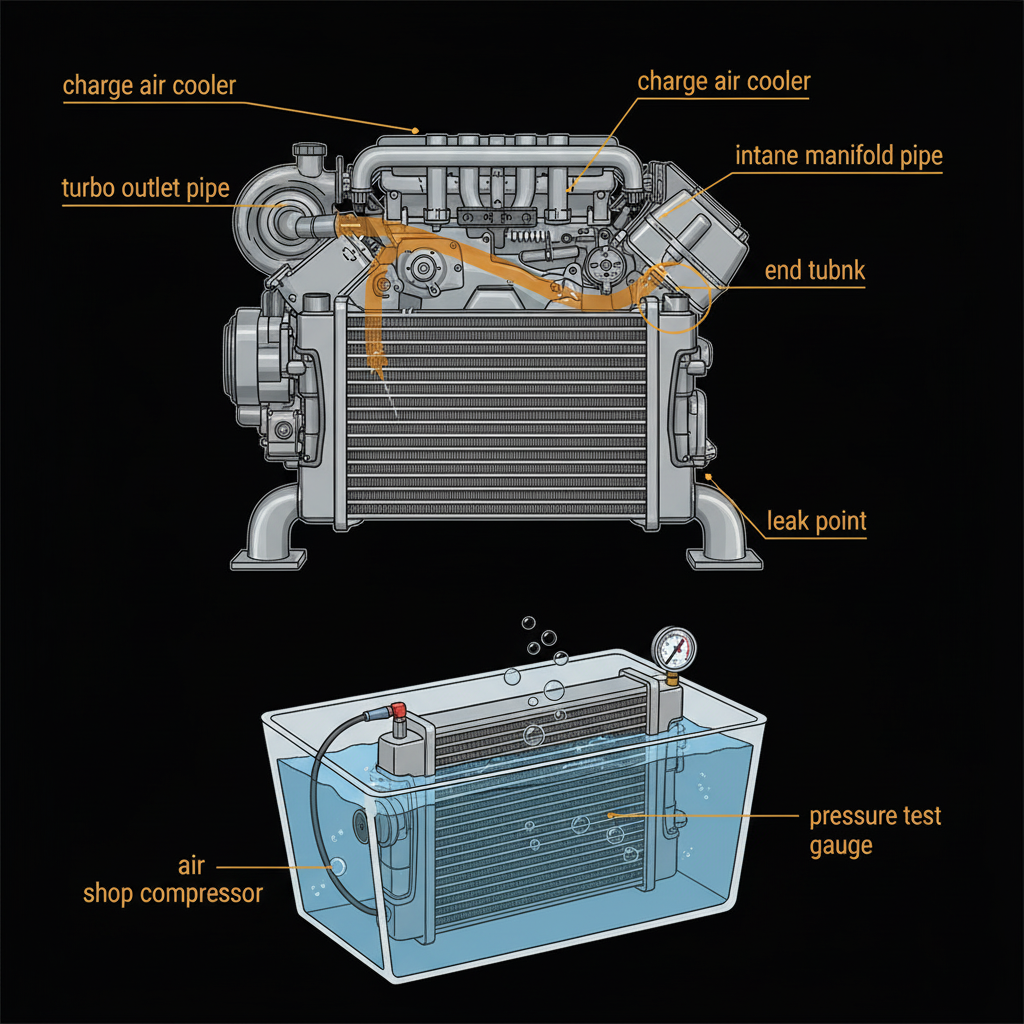
Charge air cooler (CAC) leaks are a hidden cause of low boost, high EGTs, and poor fuel economy. When compressed air escapes before reaching the engine, every system that depends on proper airflow suffers. This guide helps you find CAC leaks before you blame the turbo or injectors.
Why This Matters
- ▸ CAC leaks cause low boost and sluggish acceleration — pressure test before condemning the turbo.
- ▸ High EGTs from leaks can damage the turbo and DPF over time.
- ▸ Misdiagnosed leaks lead to unnecessary turbo replacement.
- ▸ Fleets lose fuel efficiency and power with every mile driven on a leaking CAC.
8-Step Diagnostic Flow
Perform a pressure test on the charge air system
Pressurize the charge air system (CAC and all piping) with shop air at low pressure (typically 15–20 psi). Listen and feel for leaks at the CAC core, end tanks, boots, and clamps. Use soapy water to locate small leaks. This is the most reliable way to find CAC leaks.
Inspect CAC for physical damage, oil staining, and cracked end tanks
Visually inspect the CAC core for impact damage, bent fins, and cracks. Check the end tanks (plastic or aluminum) for cracks at the crimped joint. Oil staining around the CAC indicates a leak path — trace it to the source.
Check all boots and clamps for leaks and misalignment
Charge air boots and clamps are the most common leak points. Inspect each boot for cracks, tears, and misalignment. Check clamp torque — loose clamps are a common cause of boost leaks, especially after recent service.
Compare boost pressure to commanded under load
SPN 102 (MAP). Compare actual boost to desired under load. A large delta with a sealed CAC points to turbo or VGT issues. A large delta that disappears after CAC repair confirms the CAC was the cause.
Check MAP/MAF correlation for airflow inconsistencies
SPN 102 (MAP), SPN 132 (MAF). MAP and MAF should track together under load. A CAC leak causes MAP to read low relative to MAF — the turbo is moving air, but it is escaping before reaching the engine. This correlation is a key diagnostic tool.
Inspect for excessive oil in CAC
Some oil carryover in the CAC is normal, but heavy pooling or dripping indicates turbo seal failure or excessive crankcase pressure. Drain and inspect the CAC — oil in the CAC reduces heat transfer efficiency and can cause boost loss.
Check EGR and turbo performance with verified sealed CAC
After confirming the CAC is sealed, retest boost and airflow. If boost is still low, the issue is upstream (turbo, VGT, EGR). A CAC leak can mask turbo problems — always seal the CAC before diagnosing the turbo.
Re-test boost after repairs to confirm restoration
After all repairs, perform a final boost pressure test under load. Confirm actual boost matches desired. Document the results — a sealed CAC that still shows low boost requires further diagnosis of the turbo and VGT system.
Engine-Specific Notes
Cummins ISX / X15
High-mileage Cummins fleets often see CAC core fatigue and cracking at the end tank crimps. Oil staining around the CAC is a common visual clue. Cummins recommends CAC pressure testing at each PM interval on high-mileage engines.
Detroit DD13 / DD15
CAC leaks on Detroit frequently coexist with VGT complaints. Always test the CAC before condemning the turbo. Detroit's charge air system uses multiple boots and clamps that can loosen over time, especially in high-vibration applications.
Paccar MX-13
Plastic end tanks and crimped joints on Paccar can separate over time due to thermal cycling and vibration. Cold climates and off-road use accelerate failure. Inspect mounting and support brackets for stress cracks.
Volvo / Mack MP8
CAC leaks on Volvo can cause repeated DPF and SCR issues due to poor combustion from low boost. Watch for long-term fuel economy complaints as an early indicator. Volvo's charge air routing includes several potential leak points.
CAT C13 / C15
High boost platforms on CAT are especially sensitive to CAC integrity. Small leaks can have large performance impacts. CAT recommends CAC pressure testing whenever low boost or high EGT complaints are investigated.
International A26
Fleet operations with frequent off-road use see more CAC damage on International engines. Inspect mounting and support brackets for stress. A26 charge air systems are robust but vulnerable to impact damage in vocational applications.
DVOM Test Points
| Test | Spec | Note |
|---|---|---|
| MAP sensor | 5 V reference, 0.5–4.5 V signal under load | Biased MAP causes incorrect boost calculation — verify before diagnosing CAC |
| MAF sensor (if equipped) | Frequency or voltage per OEM spec | Low MAF with normal turbo operation = intake restriction or CAC leak |
| Boost pressure sensor | Proper scaling and response per OEM spec | Verify sensor accuracy before using boost data for diagnosis |
Live Data Parameters to Monitor
Boost Pressure (actual vs desired)
Large delta under load = CAC leak, turbo, or VGT issue
MAP vs MAF Correlation
MAP low relative to MAF = air escaping between turbo and engine
EGR Flow Contribution
Verify EGR is not masking airflow data
Fuel Rate vs Torque Output
High fuel rate, low torque = combustion efficiency loss from low boost
Exhaust Temps (pre-turbo, post-turbo)
High EGTs with low boost = insufficient air for combustion
Related Fault Codes
Frequently Asked Questions
Can a small CAC leak really cause major power loss?
Yes. Even moderate leaks can significantly reduce effective boost, especially under heavy load. The turbo may be working correctly, but if compressed air escapes before reaching the engine, combustion efficiency drops and EGTs rise.
Is oil in the CAC always a sign of turbo failure?
Not always. Some oil carryover from the crankcase ventilation system is normal. Heavy pooling or dripping suggests turbo seal failure or excessive crankcase pressure. Inspect the turbo and crankcase ventilation system before condemning the turbo.
Should CACs be tested on a schedule?
Many fleets pressure-test CACs at regular intervals, especially in high-mileage or severe-duty operations. A CAC that passes pressure testing but shows oil staining should be monitored closely and retested at the next PM.
Master Airflow & CAC Diagnosis
The AI Diesel Tech Academy covers CAC pressure testing, boost system diagnostics, MAP/MAF correlation, and airflow interpretation with real-world case studies.
Explore the Academy