
SPN 3609 FMI 1 — DPF Intake Pressure Below Normal
SPN 3609 FMI 1 means the DPF inlet pressure is below the expected value for conditions. Low DPF inlet pressure is often a sensing-line issue — disconnected sense hoses after aftertreatment service are a documented cause that does not require any hardware replacement.
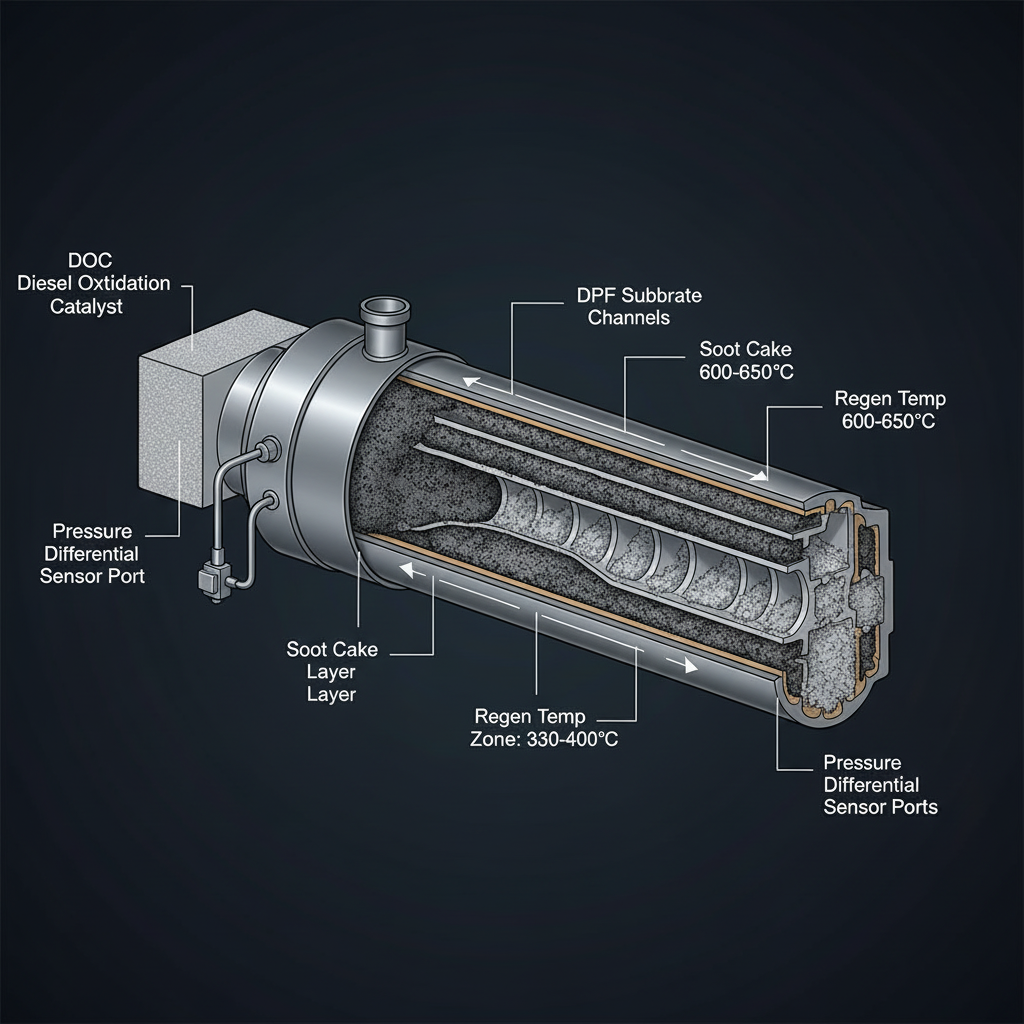
Fault Overview
FMI 1 on DPF intake pressure indicates the sensor reports below the minimum expected pressure for conditions. Sensor bias, leaking sense line, exhaust leak upstream, true low flow conditions, and wiring low-signal faults are the primary causes. Disconnected sense hoses after AT service are a documented cause of false low inlet pressure readings. An implausible low reading under load when the engine is producing exhaust flow confirms a sensing path issue rather than a true low-pressure condition.
Engine & Platform Coverage
Symptoms
- •DPF inlet pressure low fault active
- •Exhaust pressure sensor low indication
- •Aftertreatment pressure sensing fault
- •Delta-P calculation errors from low inlet pressure
- •Regen control instability from pressure sensing fault
Possible Causes
- 1.Sensor bias — pressure sensor reading below actual pressure
- 2.Leaking sense line — sense line leak producing low reading
- 3.Disconnected sense hose — hose disconnected after AT service
- 4.Exhaust leak upstream — exhaust leak reducing measured pressure
- 5.Wiring low-signal fault — low-signal circuit fault producing low reading
Diagnostic Flow — FSM Sequence
AI Diesel Tech enforces this evidence-gate sequence. Each gate must pass before advancing.
6 steps locked behind Technician Mode- 1Single Action Gate — Inspect Sense Hose Routing and Connection: Inspect the sense hose routing and connection at the DPF inlet pressure sensor. Disconnected sense hoses after AT service are a documented cause of false low inlet pressure readings. Confirm the sense hose is connected, routed correctly, and not kinked or blocked.
- 2Binary Decision Gate — Verify Sensor Baseline at KOEO: Verify the sensor baseline at KOEO. For absolute pressure sensors, the reading should be near ambient atmospheric pressure at KOEO. An implausible low reading at KOEO confirms sensor bias or a wiring fault. A reading near ambient at KOEO with implausible low under load confirms a sense line leak or exhaust leak.
- 3Override Manager — Compare to Outlet Pressure: Compare DPF inlet pressure to outlet pressure. One sensor disagreeing with the other while the engine is producing exhaust flow confirms the disagreeing sensor is suspect. Both sensors reading implausibly low simultaneously suggests a shared sensing path issue.
- 4Safety Interceptor — Circuit Checks: Perform circuit checks on the DPF inlet pressure sensor if sense line and baseline checks do not identify the fault. Verify sensor power, ground, and signal integrity. A wiring low-signal fault can produce a false low reading without any sensing path issue.
- 5Resume Point — Upstream Exhaust Leak Inspection: Inspect for exhaust leaks upstream of the DPF inlet pressure sensor. An exhaust leak upstream of the sensor reduces the measured pressure below the actual DPF inlet pressure. Inspect exhaust manifold, turbo outlet, and AT inlet connections for leaks.
- 6Verification Loop — Post-Repair Pressure Confirmation: After repair, verify DPF inlet pressure reads near ambient at KOEO and rises appropriately under load. Confirm delta-P calculation returns to normal. Monitor for return of FMI 1 over extended operation.
- 7Repair Ledger Output — Hose, Sensor, or Exhaust Leak Decision: Reconnect or replace sense hose if disconnected or leaking. Replace sensor if bias is confirmed after sense line integrity is proven. Repair upstream exhaust leak if confirmed. Do not replace AT hardware for a sensing path fault.
Unlock the full evidence-gated diagnostic sequence, DVOM test steps, and repair procedures in Technician Mode.
Repair Steps
2 steps locked- 1Reconnect or replace sense hose if disconnected or leaking.
- 2Replace sensor if bias is confirmed after sense line integrity is proven.
- 3Repair upstream exhaust leak if confirmed.
- 4Repair wiring low-signal fault if circuit check confirms wiring fault.
Unlock full diagnostic steps, DVOM tests, and repair procedures.
Full Diagnostic Access
Verification steps, preventative measures, severity guidance, and legacy comparison are available in Technician Mode.
Start Diagnosing This Fault Now
AI Diesel Tech walks you through every evidence gate in the correct order. Choose the plan that fits your shop.
Related Resources
Related Fault Codes
Related Systems
Related Fault Codes
Related Sensor Locations
Common Symptoms
AI Diesel Tech — The Technician's Diagnostic Engine
AI Diesel Tech diagnostic logic is built by an ASE Certified Diesel Technician and engineered for professional shop use. Trusted by technicians nationwide — used in shops, fleets, and training programs.
Summary
Low DPF inlet pressure is often a sensing-line issue. The AI Diesel Tech FSM enforces sense-line verification before AT hardware replacement.