
Aftertreatment Diagnosis
DPF Won't Regen
A DPF that won't regenerate is one of the most common global diesel failures. This USA-built diagnostic guide covers soot load, ash load, regen logic, exhaust temp sensors, and forced regen failures for all major engine families.
Why This Matters
- ▸ DPF full. Truck derated. Fleet losing money.
- ▸ Regen failure leads to progressive derate and eventual shutdown.
- ▸ Unnecessary DPF replacement costs $2,000–$6,000 — most failures are sensor or dosing issues.
- ▸ Built on American diesel aftertreatment standards with global engine coverage.
Regen Recovery Diagnostic Flow
Check soot load
Soot load >80% triggers active regen request. >100% = regen required immediately. >120% = derate. Monitor via scan tool — do not rely on dash lamp alone.
Check ash load
Ash load >100% = DPF service required. Ash cannot be burned off — it requires physical cleaning or filter replacement. Regen will not reduce ash load.
Check DPF pressure sensor
SPN 3251 (DPF differential pressure). High pressure at low soot load = sensor fault or physical restriction. Low pressure at high soot load = sensor fault.
Check exhaust temp sensors
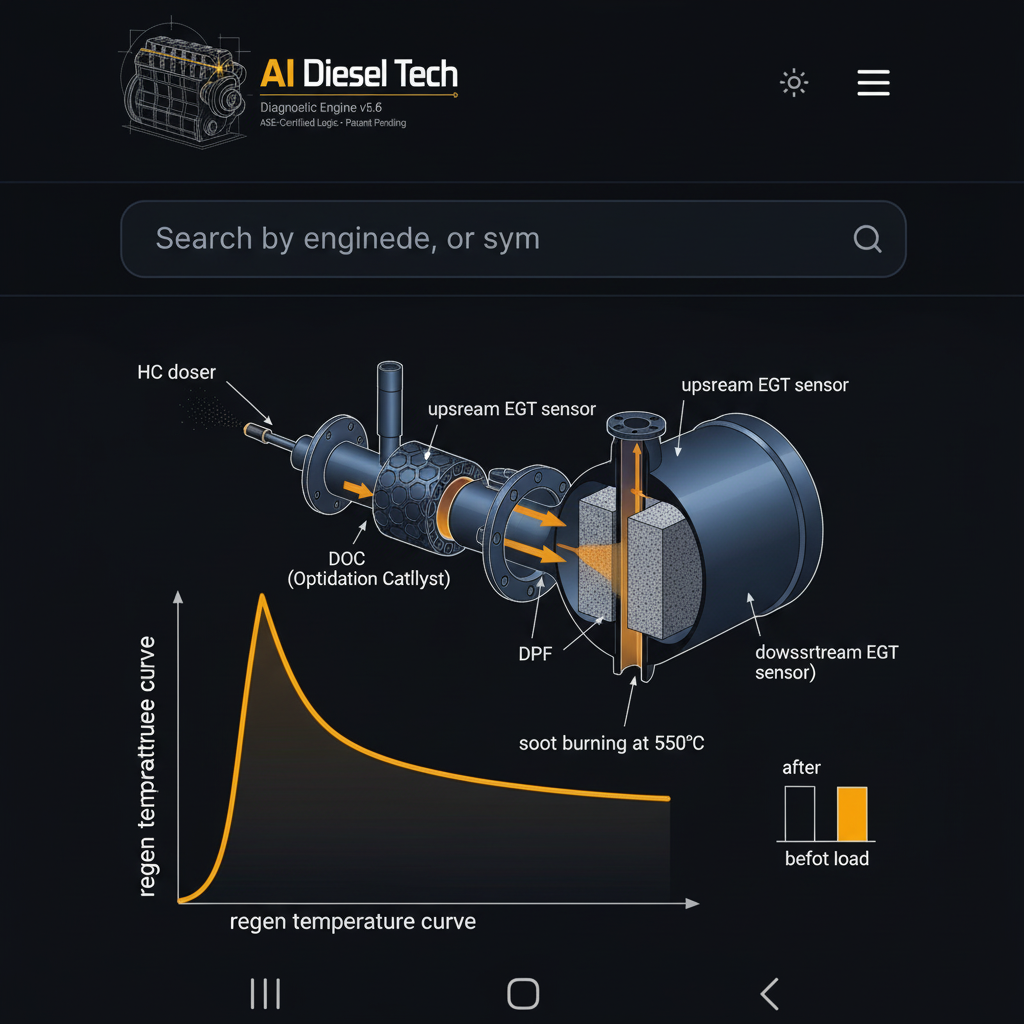
DOC inlet (SPN 3242), DPF inlet (SPN 3246), SCR inlet (SPN 4360). Regen requires DOC outlet ≥550°C. Low temps = DOC failure, exhaust leak, or fuel dosing fault.
Check NOx sensors
Biased NOx sensors can cause false SCR efficiency faults that abort regen before completion. Compare inlet vs outlet NOx during regen.
Check DEF quality
Poor DEF quality causes SCR efficiency faults that abort active regen. Test DEF concentration before condemning the DPF or regen system.
Check regen history
Frequent aborted regens indicate a systemic issue — not just a full DPF. Check regen abort reason codes (SPN 3701, 3702) to identify the specific abort trigger.
Check passive vs active regen capability
Passive regen requires sustained highway speeds (≥55 MPH) and exhaust temps ≥300°C. Short-trip, low-load duty cycles prevent passive regen and accelerate soot accumulation.
Engine-Specific Regen Patterns
Cummins ISX / X15
Common regen failure: SPN 3031 (soot high), SPN 3251 (DP sensor), SPN 3242/3246 (temp sensors). Cummins uses post-injection for active regen — check fuel system before condemning DOC.
Detroit DD Series
Detroit uses a 7th injector (hydrocarbon injector) for active regen. Common failure: HC injector clogging or circuit fault. Check SPN 3609 (HC injector) before exhaust temp diagnosis.
Paccar MX-13
MX engines use post-injection for regen. Common regen abort: low exhaust temps due to EGR cooler restriction or intake restriction reducing combustion efficiency.
Volvo / Mack MP8
Volvo D13 uses a separate fuel dosing unit (FDU) for active regen. Check FDU operation and fuel supply to the FDU before diagnosing DOC or DPF.
CAT C13 / C15
CAT uses a diesel oxidation catalyst (DOC) and DPF in series. Check DOC efficiency (SPN 3242 vs 3246 temp differential) before condemning the DPF.
International A26
A26 shares Cummins aftertreatment architecture. Follow Cummins ISX/X15 regen logic. Check post-injection fuel quantity and DOC inlet temp during regen attempt.
DVOM Testing Block
| Test | Spec | Note |
|---|---|---|
| DPF pressure sensor | 0.5V at 0 inH₂O, 4.5V at max range | Stuck signal = false soot load reading; verify with known-good sensor or mechanical gauge |
| Exhaust temp sensors | 0.5–4.5V signal, <0.5V ground drop | High resistance ground causes low-reading temp sensor and false regen abort |
| DEF pump circuit | 12–14V supply at pump connector | Low voltage prevents DEF dosing during regen, causing SCR efficiency abort |
| NOx sensor supply | 12–14V, <0.1V ground drop | Voltage drop causes NOx sensor bias and false SCR efficiency faults during regen |
Live Data Parameters to Monitor
Soot Load (%)
<80% normal; >100% regen required; >120% derate
Ash Load (%)
<100% — above this requires DPF service
DPF Differential Pressure
Engine-specific; compare to soot load for sensor rationality
DOC Outlet Temp
≥550°C during active regen for DPF light-off
Regen Status
Active / Passive / Inhibited / Aborted
SCR Efficiency (%)
≥70% — low efficiency aborts regen
Related Fault Codes
Frequently Asked Questions
Why won't my DPF do a forced regen?
Forced regen requires specific preconditions: engine at operating temp, no active inhibit faults, vehicle stationary (for parked regen), and no active derate conditions. Common inhibit causes: low coolant temp, active fault codes, low fuel level, or a regen inhibit switch in the cab. Check SPN 3701/3702 for the specific abort reason.
What's the difference between soot load and ash load?
Soot load is combustible carbon that burns off during regen — it goes up and down with duty cycle. Ash load is non-combustible residue from engine oil additives — it only goes up and requires physical DPF cleaning or replacement. A DPF with 100% ash load will never regen successfully regardless of how many times you attempt it.
How do I know if my DOC is working?
During active regen, the DOC should increase exhaust temperature by 150–250°C between inlet and outlet. If DOC inlet temp is 300°C and outlet is also 300°C, the DOC is not oxidizing the injected fuel. Common causes: DOC catalyst poisoning (from oil or coolant contamination), DOC physical damage, or insufficient fuel dosing.
Learn Aftertreatment Sensor Testing
The DVOM & Multimeter Fundamentals course covers DPF pressure sensors, exhaust temp sensors, and DEF pump circuit testing.
View DVOM Course