
DPF Soot Load Diagnosis
DPF Soot Load High
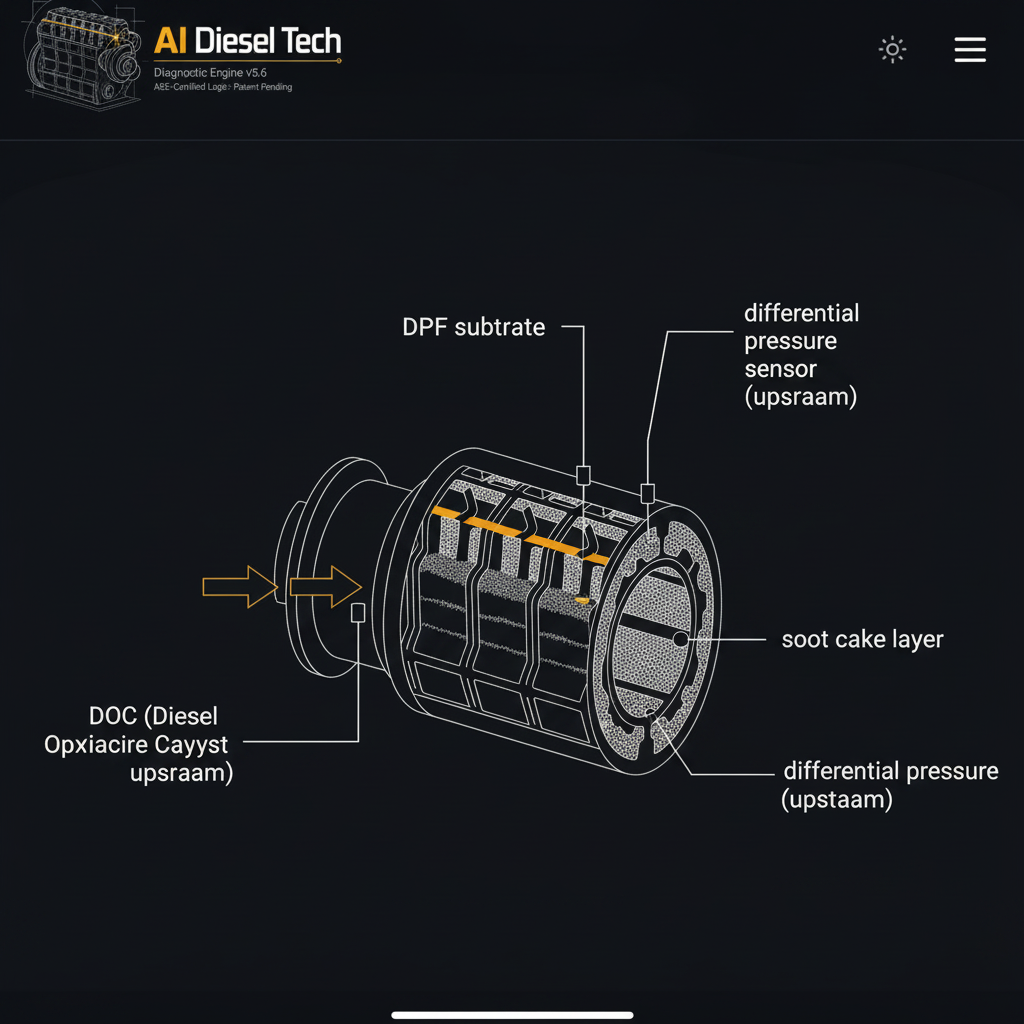
High soot load is one of the most common diesel failures worldwide. When soot accumulates faster than the system can burn it off, regens fail, backpressure rises, and the engine enters protection mode. This guide covers soot logic, regen triggers, and how to diagnose soot overload for Cummins, Detroit, Paccar, Volvo, CAT, and International engines.
Why This Matters
- ▸ High soot load triggers frequent or failed regens — find the root cause before replacing the DPF.
- ▸ Excess soot leads to 5 MPH derate and forced downtime if left unaddressed.
- ▸ Soot overload can crack or melt the DPF substrate — a very expensive failure.
- ▸ Ignoring soot load increases fuel consumption and maintenance cost fleet-wide.
8-Step Diagnostic Flow
Verify soot load % in live data
Compare ECM-calculated soot load to actual DPF differential pressure. A high soot reading with normal differential pressure often indicates a sensor or calculation error rather than true soot overload. Verify both data points before proceeding.
Check DPF differential pressure
SPN 3251 (DPF differential pressure). Measure at idle and under load. High differential pressure confirms physical soot restriction. Low differential pressure with high calculated soot = suspect the pressure sensor or ECM model.
Check exhaust temp sensors for accuracy
SPN 3242, 3246 (exhaust temps). Regen effectiveness depends on accurate temperature readings. A drifted EGT sensor can cause the ECM to abort regens prematurely or fail to trigger them at all. Verify sensor resistance against OEM temp chart.
Review regen history
Check how many regens have been attempted, completed, and aborted. Frequent aborted regens indicate a systemic issue — low EGTs, doser failure, or sensor problems. A long history of incomplete regens explains high soot accumulation.
Check passive regen capability
Passive regen requires sustained highway operation with EGTs above 550°C (1022°F). Vehicles in stop-and-go or low-load duty cycles cannot passively regen. Verify the duty cycle before diagnosing active regen failures.
Check active regen triggers and doser operation
Active regen requires the doser injector to fire fuel into the exhaust stream to raise EGTs. Check doser command, fuel supply to the doser, and doser current draw. A failed doser means no active regen capability.
Inspect for fuel system issues causing rich combustion
Injector balance rate problems, EGR valve issues, and turbo inefficiency all increase soot production. High soot load with normal regen function points to upstream combustion problems rather than aftertreatment failure.
Check EGR flow and turbo performance
EGR imbalance and low boost both increase soot production. Verify EGR differential pressure and MAP/MAF correlation. A stuck EGR valve or low boost condition can overwhelm the DPF faster than regens can keep up.
Engine-Specific Notes
Cummins ISX / X15
Faulty DPF pressure sensors often cause false high soot readings on Cummins platforms. Always correlate pressure sensor voltage with actual differential pressure before condemning the DPF. Cummins uses a calculated soot model that can diverge from actual conditions.
Detroit DD13 / DD15
Doser injector failures lead to incomplete regens and soot buildup on Detroit engines. SCR and DPF issues often appear together. Check doser operation and fuel supply before diagnosing the DPF substrate.
Paccar MX-13
EGR imbalance can spike soot production quickly on MX-13 engines. Watch for EGR differential pressure and MAP/MAF correlation. Paccar's soot model is sensitive to EGR contribution — verify EGR function before blaming the DPF.
Volvo / Mack MP8
Temperature sensor drift can mislead the ECM about regen effectiveness on Volvo platforms. Verify EGT sensor readings with DVOM and compare to live data. A drifted sensor can cause repeated regen attempts without actually reducing soot.
CAT C13 / C15
Turbo efficiency loss increases soot production at all loads on CAT engines. Check boost and air-fuel ratio before blaming the DPF. CAT's soot model is closely tied to combustion efficiency — turbo and EGR issues show up as high soot quickly.
International A26
DEF and SCR issues can cascade into soot problems on International engines. Look at the entire aftertreatment chain, not just the DPF. A26 engines in vocational applications often see accelerated soot accumulation due to duty cycle.
DVOM Test Points
| Test | Spec | Note |
|---|---|---|
| DPF pressure sensor | 0.5–4.5 V signal, 5 V reference | Out-of-range signal = sensor failure; check for blocked pressure lines first |
| Exhaust temp sensors | Resistance per OEM temp vs resistance chart | Drifted sensor causes incorrect regen trigger and abort decisions |
| Doser injector | 12 V supply, proper current draw during command | No current draw during command = failed doser or wiring issue |
| DEF pump (if integrated with regen logic) | 12 V supply, 4–6 A draw | Verify DEF system is not contributing to regen failures |
Live Data Parameters to Monitor
Soot Load % (ECM calculated)
<80% normal — above 100% = regen required immediately
Ash Load % (service indicator)
Tracks DPF cleaning interval — high ash = physical cleaning needed
DPF Differential Pressure (kPa)
Rises with soot — correlate with calculated soot load
Exhaust Temps (pre-DPF, mid-DPF, post-DPF)
Regen requires sustained temps above 550°C at DPF inlet
Regen Status (active, complete, aborted)
Frequent aborts = systemic issue; check doser and EGT sensors
Fuel Rate During Regen
Higher than normal = doser firing; zero during active regen = doser failure
Related Fault Codes
Frequently Asked Questions
Can high soot load be cleared without a regen?
No. Soot must be oxidized (burned) during regen. A forced regen via scan tool or normal driving regen is required to reduce soot load. Simply clearing the fault code does not reduce physical soot in the DPF.
Does high soot always mean the DPF is bad?
Not necessarily. High soot can be a symptom of upstream issues (turbo, EGR, fuel system) or sensor errors. Ash load and physical inspection tell you more about DPF substrate health. Always diagnose the root cause before replacing the DPF.
How often should a DPF be cleaned?
Ash accumulation, not soot, determines cleaning intervals. Many fleets clean between 300,000–500,000 miles, but severe duty cycles, oil consumption, and coolant leaks may require more frequent service. Always check ash load alongside soot load.
Master DPF & Aftertreatment Diagnosis
The AI Diesel Tech Academy covers DPF soot and ash logic, regen triggers, pressure sensor testing, and doser diagnostics with real-world case studies.
Explore the Academy