
SPN 3031 FMI 18 — DPF Soot Load Below Normal (Model Conflict)
SPN 3031 FMI 18 means the soot model indicates below-normal soot versus other indicators — treat this as a soot-model conflict requiring correlation, not a 'good filter' assumption. Below-normal soot readings still require correlation with delta-P and service history.
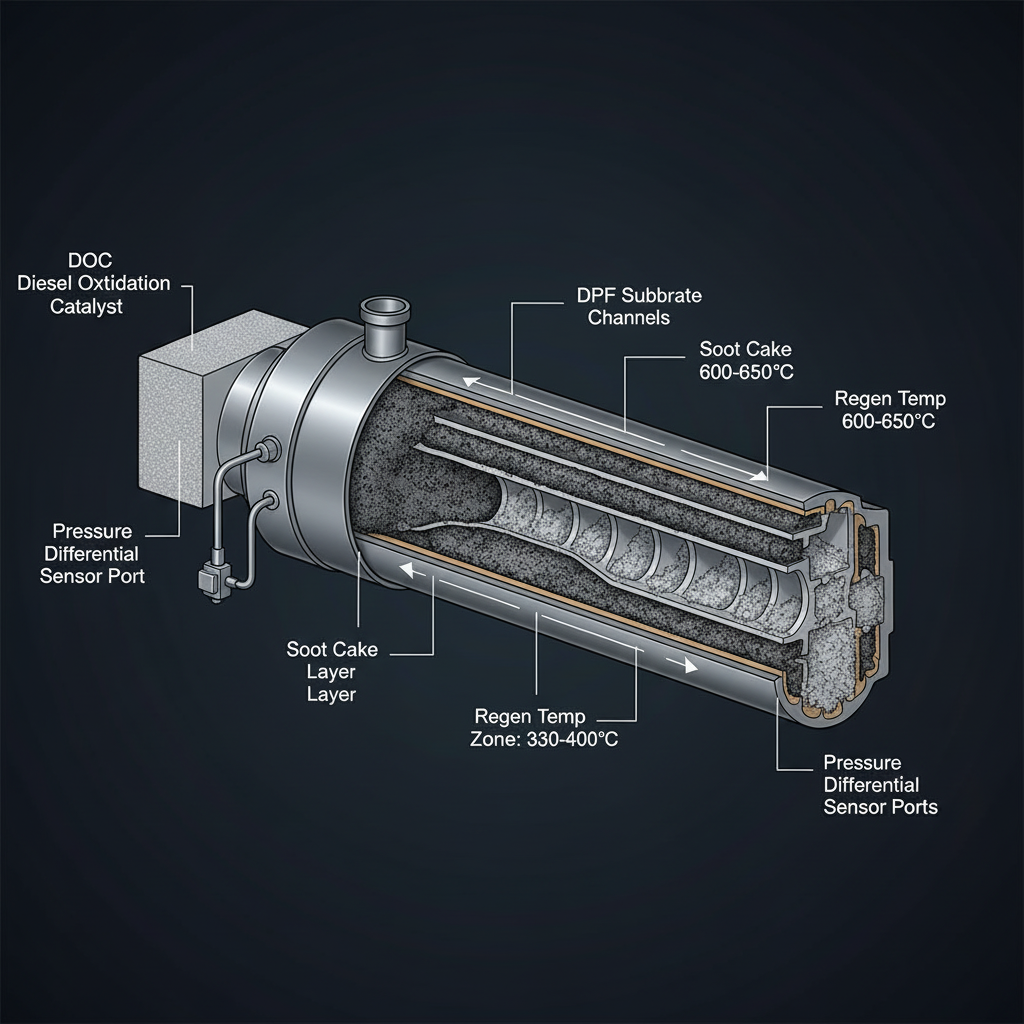
Fault Overview
FMI 18 on DPF soot load indicates the soot model reports below the expected minimum for conditions, or the model conflicts with other indicators. Faulty delta-P inputs, bad temperature sensors affecting the model, software model drift, recent DPF service without required reset or adaptation, and sensor replacement without calibration process are the primary causes. DPF replaced or cleaned without proper service resets leading to model confusion is a documented pattern on some platforms. An implausible 'always low soot' reading with high delta-P is a conflict that requires investigation — not a confirmation that the filter is clean.
Engine & Platform Coverage
Symptoms
- •DPF soot load below normal fault active
- •Soot model mismatch indication
- •Regen strategy behaving unexpectedly
- •DPF sensor disagreement
- •Model conflict after DPF service
Possible Causes
- 1.Faulty delta-P inputs — delta-P sensor or hose fault affecting soot model
- 2.Bad temperature sensors — EGT sensor fault affecting soot estimation
- 3.Software model drift — model calibration drift over time
- 4.DPF service without reset — DPF replaced or cleaned without required service reset
- 5.Sensor replacement without calibration — sensor replaced without required adaptation process
Diagnostic Flow — FSM Sequence
AI Diesel Tech enforces this evidence-gate sequence. Each gate must pass before advancing.
6 steps locked behind Technician Mode- 1Single Action Gate — Compare Soot Percentage to Delta-P: Compare the soot load percentage to the delta-P reading. An implausible "always low soot" reading with high delta-P is a conflict — the model is not tracking the actual filter condition. A soot reading that correlates with delta-P and regen frequency confirms the model is tracking correctly.
- 2Binary Decision Gate — Verify Delta-P Sensor and Hoses: Verify delta-P sensor and hose integrity. Faulty delta-P inputs are the most common cause of soot model conflicts. Inspect hoses for contamination and blockage. Verify sensor baseline at KOEO is near zero differential pressure.
- 3Override Manager — Verify EGT Sensor Integrity: Verify EGT sensor integrity. Bad temperature sensors affecting the soot model can produce below-normal soot readings without any actual filter condition change. Compare EGT readings to expected values for operating conditions.
- 4Safety Interceptor — Check Service Reset Status: Check service reset status after any recent DPF service. DPF replaced or cleaned without proper service resets leads to model confusion on some platforms. Follow OEM model relearn procedures if a service reset was not performed after DPF service.
- 5Resume Point — OEM Model Relearn Procedures: Follow OEM model relearn procedures if model drift or post-service confusion is confirmed. Some platforms require specific adaptation procedures after DPF service to re-establish the soot model baseline.
- 6Verification Loop — Post-Repair Model Correlation Confirmation: After repair, verify soot load percentage correlates with delta-P and regen frequency. Confirm the model is tracking actual filter condition. Monitor for return of model conflict over extended operation.
- 7Repair Ledger Output — Sensor, Reset, or Model Relearn Decision: Repair or replace delta-P sensor or hoses if faulty inputs are confirmed. Repair or replace EGT sensor if temperature sensor fault is confirmed. Perform OEM model relearn if post-service model confusion is confirmed. Address actual restriction if present after model correction.
Unlock the full evidence-gated diagnostic sequence, DVOM test steps, and repair procedures in Technician Mode.
Repair Steps
2 steps locked- 1Repair or replace delta-P sensor or hoses if faulty inputs are confirmed.
- 2Repair or replace EGT sensor if temperature sensor fault is confirmed.
- 3Perform OEM service reset and model relearn after DPF service.
- 4Address actual restriction if present after model correction.
Unlock full diagnostic steps, DVOM tests, and repair procedures.
Full Diagnostic Access
Verification steps, preventative measures, severity guidance, and legacy comparison are available in Technician Mode.
Start Diagnosing This Fault Now
AI Diesel Tech walks you through every evidence gate in the correct order. Choose the plan that fits your shop.
Related Resources
Related Fault Codes
Related Systems
Related Fault Codes
Related Sensor Locations
Common Symptoms
AI Diesel Tech — The Technician's Diagnostic Engine
AI Diesel Tech diagnostic logic is built by an ASE Certified Diesel Technician and engineered for professional shop use. Trusted by technicians nationwide — used in shops, fleets, and training programs.
Summary
Below-normal soot readings still require correlation with delta-P and service history. The AI Diesel Tech FSM enforces multi-signal correlation to prevent ignoring a model conflict as a 'good filter' assumption.