
P2002 — Diesel Particulate Filter Efficiency Below Threshold
P2002 means the DPF efficiency monitor is below the required threshold. Sensor integrity and upstream proof are required before DPF condemnation — the monitor fails on sensor faults and short-trip cycles as well as actual filter failure.
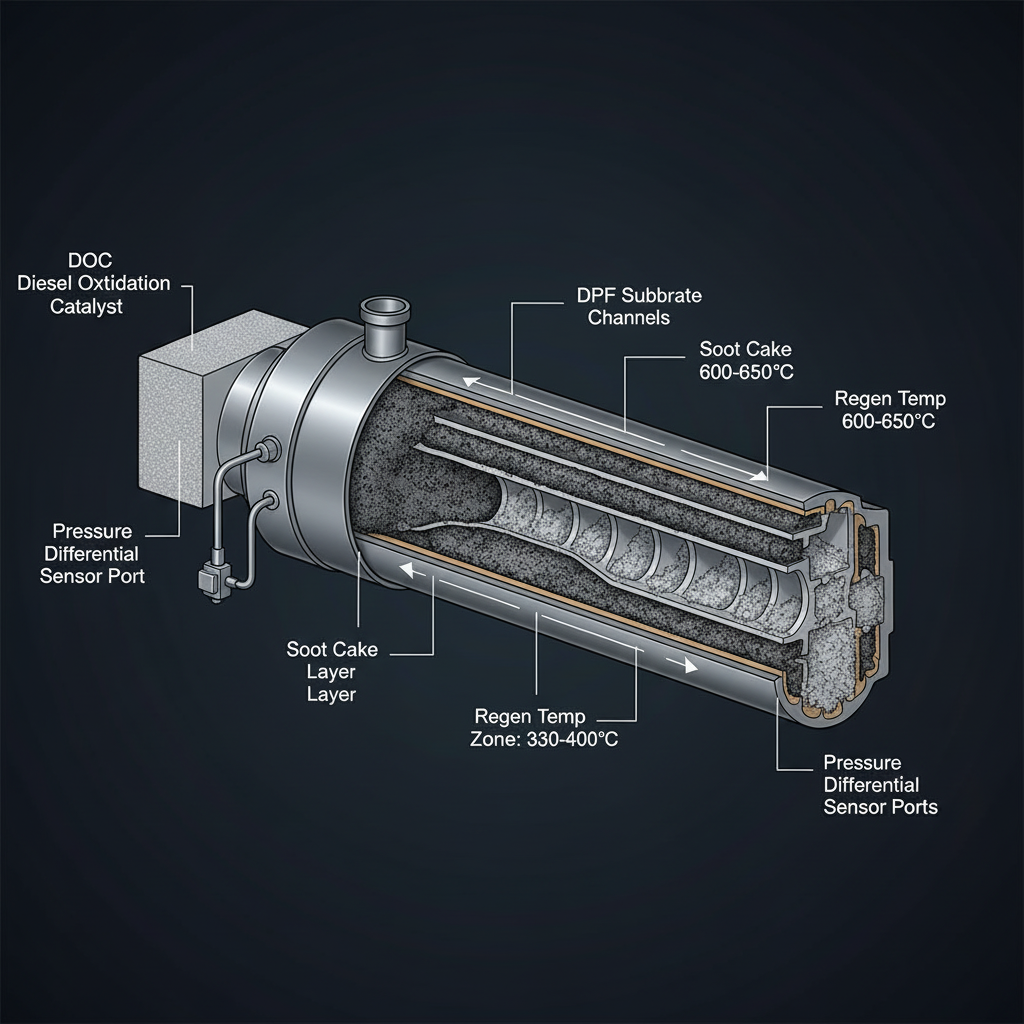
Fault Overview
P2002 indicates the DPF efficiency monitor has detected below-threshold performance. Loaded or damaged DPF, failed sensors feeding the monitor, incomplete regens, and upstream over-soot conditions are the primary causes. The monitor fails after repeated short-trip cycles that prevent regen completion and sensor faults that misread as a failed filter are documented patterns. Replacing the DPF based on the monitor code alone without sensor integrity and upstream proof is the most expensive misdiagnosis on P2002.
Engine & Platform Coverage
Symptoms
- •P2002 DPF efficiency fault active
- •DPF not effective indication
- •DPF soot efficiency fault
- •Diesel particulate filter efficiency low
- •Progressive derate from DPF efficiency monitor
Possible Causes
- 1.Loaded or damaged DPF — filter restriction or substrate damage
- 2.Failed sensors feeding monitor — delta-P or EGT sensor fault affecting efficiency calculation
- 3.Incomplete regens — repeated short-trip cycles preventing regen completion
- 4.Upstream over-soot — underboost or EGR fault increasing soot production
- 5.Monitor failure from short trips — monitor fails without actual filter failure
Diagnostic Flow — FSM Sequence
AI Diesel Tech enforces this evidence-gate sequence. Each gate must pass before advancing.
6 steps locked behind Technician Mode- 1Single Action Gate — Sensor Integrity Check: Verify delta-P sensor and EGT sensor integrity before any DPF hardware decision. Failed sensors feeding the efficiency monitor can produce P2002 without any actual filter failure. Confirm sensor baselines and circuit integrity before proceeding to regen history.
- 2Binary Decision Gate — Regen History Review: Review regen history and completion rates. Repeated short-trip cycles that prevent regen completion are a documented cause of P2002 without actual filter failure. A history of incomplete regens confirms the monitor failed from regen strategy rather than filter failure.
- 3Override Manager — Upstream Contributor Assessment: Assess upstream soot contributors. Underboost from a charge air leak or turbo fault increases soot production and accelerates DPF loading. EGR faults that increase soot production contribute to rapid DPF loading. Address upstream contributors before DPF service.
- 4Safety Interceptor — Successful Regen Attempt After Root-Cause Correction: Attempt a successful regen after sensor integrity and upstream causes are confirmed. A successful regen after root-cause correction confirms the filter is not failed. A regen that still fails after root-cause correction confirms filter restriction.
- 5Resume Point — Delta-P and Soot Load Correlation: Correlate delta-P and soot load percentage. A high delta-P with high soot load confirms filter restriction. A low delta-P with a P2002 monitor code confirms a sensor or monitor fault rather than filter failure.
- 6Verification Loop — Post-Repair Monitor Confirmation: After repair, verify the DPF efficiency monitor passes. Confirm P2002 does not return after a complete drive cycle. Monitor for return of efficiency faults over extended operation.
- 7Repair Ledger Output — Sensor, Regen, or DPF Decision: Repair or replace sensors if sensor fault is confirmed. Address upstream contributors if over-soot is confirmed. Perform successful regen after root-cause correction. Service or replace DPF only after sensor integrity and upstream proof confirm filter restriction.
Unlock the full evidence-gated diagnostic sequence, DVOM test steps, and repair procedures in Technician Mode.
Repair Steps
2 steps locked- 1Repair or replace delta-P or EGT sensor if sensor fault is confirmed.
- 2Address upstream soot contributors — underboost, EGR faults.
- 3Perform successful regen after root-cause correction.
- 4Service or replace DPF only after sensor integrity and upstream proof confirm filter restriction.
Unlock full diagnostic steps, DVOM tests, and repair procedures.
Full Diagnostic Access
Verification steps, preventative measures, severity guidance, and legacy comparison are available in Technician Mode.
Start Diagnosing This Fault Now
AI Diesel Tech walks you through every evidence gate in the correct order. Choose the plan that fits your shop.
Related Resources
Related Fault Codes
Related Systems
Related Fault Codes
Related Sensor Locations
Common Symptoms
AI Diesel Tech — The Technician's Diagnostic Engine
AI Diesel Tech diagnostic logic is built by an ASE Certified Diesel Technician and engineered for professional shop use. Trusted by technicians nationwide — used in shops, fleets, and training programs.
Summary
P2002 needs sensing and upstream proof before DPF condemnation. The AI Diesel Tech FSM stops automatic DPF replacement on monitor codes alone.