
Injector Diagnosis
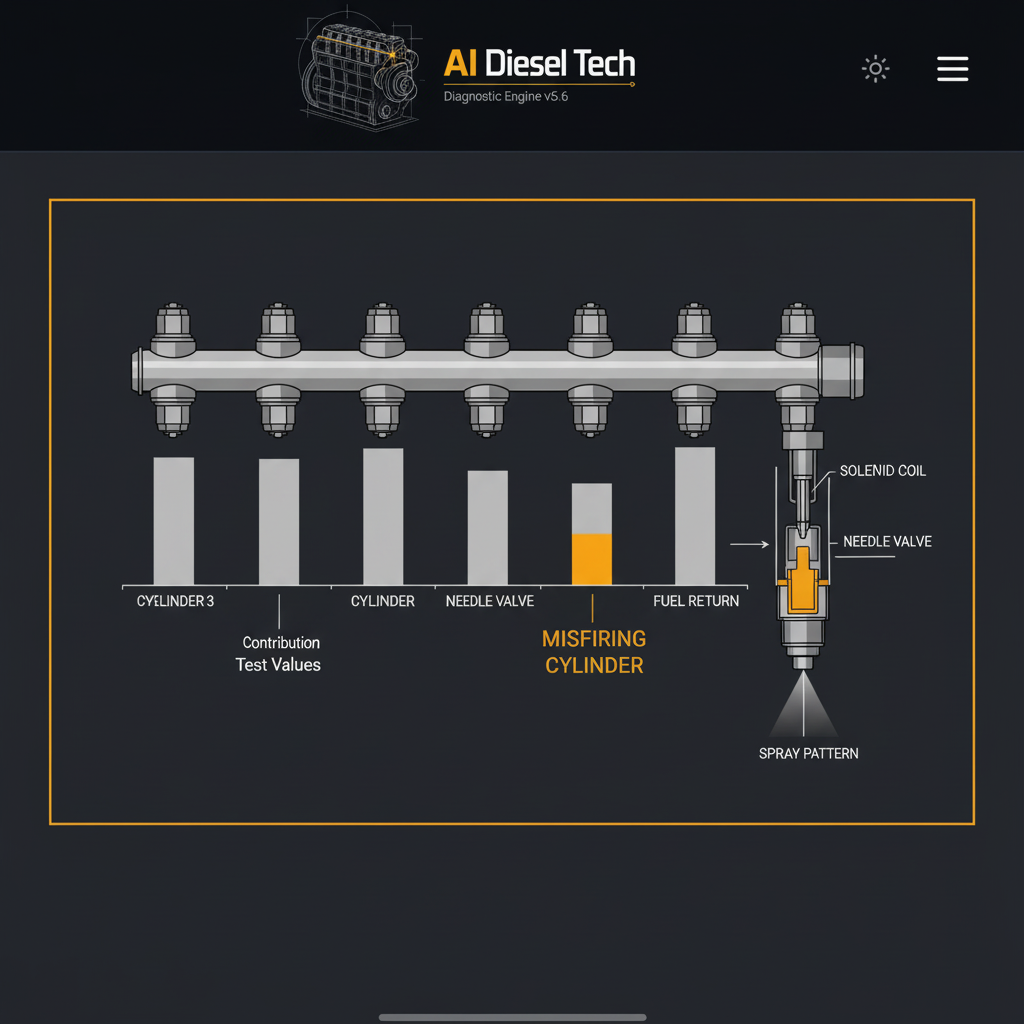
Injector Balance / Misfire
Injector misfires cause rough idle, low power, smoke, and no-start conditions worldwide. This USA-built diagnostic guide covers balance rates, return flow, injection quantity, and cylinder contribution testing for Cummins, Detroit, Paccar, Volvo, CAT, and International engines.
Why This Matters
- ▸Misfiring injectors cause unburned fuel to enter the DPF, accelerating soot load and damaging the aftertreatment system.
- ▸A single failed injector can cause piston damage from hydraulic lock — diagnose before continued operation.
- ▸Balance rate faults are the first sign of injector wear — catch them early before they cascade into DPF and SCR faults.
7-Step Diagnostic Flow
Check balance rates
Balance rates show how much fuel trim each injector requires to maintain equal cylinder contribution. A balance rate outside ±3 mm³/stroke indicates injector wear or failure. Positive balance rate = injector delivering less than commanded (worn/clogged). Negative = delivering more (stuck open or leaking).
Check return flow
Perform a return flow test at idle and at 1,000 RPM. Compare each injector's return volume. High return from one injector = worn needle or tip failure. High return from all injectors = low FRP causing over-fueling or worn injector set. Return flow spec varies by OEM — consult service data.
Check injection quantity
SPN 651–658 (injector quantity per cylinder). Verify commanded vs actual injection quantity. A cylinder with low actual quantity despite correct commanded quantity = injector restriction or solenoid failure. A cylinder with high actual quantity = stuck-open injector or return circuit failure.
Check FRP contribution
Low FRP causes all injectors to under-deliver, presenting as uniform negative balance rates across all cylinders. If all balance rates are negative and FRP is low, diagnose the fuel supply system before condemning injectors. Injector diagnosis is only valid at correct FRP.
Check cylinder contribution
Perform a cylinder cut-out test — disable one injector at a time and monitor RPM drop. A cylinder with no RPM drop when cut = failed injector or no compression. A cylinder with excessive RPM drop = that injector is carrying extra load to compensate for a weak cylinder.
Check compression
Low compression on one cylinder causes the ECM to increase fueling on that cylinder to maintain RPM, presenting as a negative balance rate. Perform a compression test before condemning the injector — a worn ring or valve causes the same symptom as a stuck-open injector.
Check fuel quality
Water or DEF contamination causes injector tip erosion that presents as high return flow and poor balance rates across multiple cylinders. Check fuel color and odor. If contamination is suspected, drain the tank and inspect the HP pump for metal debris before replacing injectors.
Engine-Specific Notes
Cummins ISX / X15
Cummins uses SPN 651–658 for injector quantity. Balance rate spec is ±3 mm³/stroke at idle. Cummins X15 injector failures often present as high return flow on one cylinder — perform a return flow test before condemning the injector based on balance rate alone.
Detroit DD13 / DD15
Detroit uses a cylinder contribution test rather than balance rates. Disable each injector and monitor RPM drop. Detroit DD15 injector solenoid failures are common at high mileage — check solenoid resistance (0.3–0.5 Ω) before performing a return flow test.
Paccar MX-13
MX-13 uses Delphi injectors. Balance rate spec is ±2.5 mm³/stroke. MX injector tip failures are common with water-contaminated fuel — check fuel quality before condemning the injector. MX injector return flow test requires a Paccar-specific adapter kit.
Volvo / Mack MP8
Volvo D13 uses Bosch CRIN injectors. Balance rate spec is ±3 mm³/stroke. Volvo injector failures often present as rough idle that clears at cruise — check balance rates at idle and at 1,000 RPM. Volvo injector return flow test is performed at 1,000 RPM.
CAT C13 / C15
CAT uses HEUI (hydraulic electronic unit injectors) on older platforms and common rail on newer C13/C15. HEUI injector failures present as low injection quantity with correct ICP (injection control pressure). Common rail C15 injector failures present as high return flow.
International A26
A26 shares Cummins injector architecture. Follow Cummins balance rate logic. A26 injector failures are less common than Cummins but still occur at high mileage. Check fuel quality first — A26 is sensitive to water contamination causing injector tip erosion.
DVOM Test Points
| Test | Spec | Note |
|---|---|---|
| Injector solenoid resistance | Per OEM spec (typically 0.3–2 Ω) | High resistance = restricted injection; open circuit = no injection on that cylinder |
| Injector harness voltage | 12–14V supply during injection command | Low voltage causes weak injection pulse and poor balance rates |
| Injector ground circuit | <0.1V voltage drop on ground circuit | High resistance ground causes weak injection and intermittent misfires |
| Injector coil inductance | Per OEM spec — use LCR meter | Low inductance indicates shorted coil windings causing over-fueling |
Live Data Parameters to Monitor
Balance Rates (mm³/stroke)
±3 mm³/stroke at idle — outside range = injector fault
Injection Quantity per Cylinder
Compare cylinders — outlier = failed injector
FRP Actual vs Desired
Must be within spec before diagnosing injectors
Cylinder Contribution (%)
Each cylinder should contribute equally — low = failed injector or compression
Return Flow (mL/min)
Compare cylinders — high return from one = worn injector tip
Misfire Count per Cylinder
Any misfire count = investigate that cylinder first
Related Fault Codes
Frequently Asked Questions
What does a bad injector balance rate mean?
Balance rate is the fuel trim applied to each injector to maintain equal cylinder contribution. A positive balance rate means the ECM is adding fuel to that cylinder — the injector is delivering less than commanded (worn, clogged, or restricted). A negative balance rate means the ECM is reducing fuel — the injector is delivering more than commanded (stuck open, leaking, or failed return circuit). Balance rates outside ±3 mm³/stroke indicate injector fault.
Can a misfire damage the DPF?
Yes. A misfiring injector allows unburned fuel to pass through the exhaust and into the DPF. Unburned fuel in the DPF causes uncontrolled regeneration (thermal runaway), which can melt the DPF substrate. A single failed injector can destroy a DPF in hours of operation. Diagnose and repair injector misfires before returning the truck to service.
How do I know if I need new injectors or just cleaning?
Injector cleaning is effective for minor deposit buildup causing slightly elevated balance rates (±3–5 mm³/stroke). If balance rates are outside ±5 mm³/stroke, or if return flow is high, cleaning will not restore injector performance — replacement is required. Perform a return flow test before deciding: high return flow = mechanical wear that cleaning cannot fix.
Master Injector Diagnosis
The AI Diesel Tech Academy covers injector balance rates, return flow, solenoid testing, and cylinder contribution in depth — with DVOM procedures, live data interpretation, and real-world case studies.
Explore the Academy