
EGR Cooler Diagnosis
EGR Cooler Failure
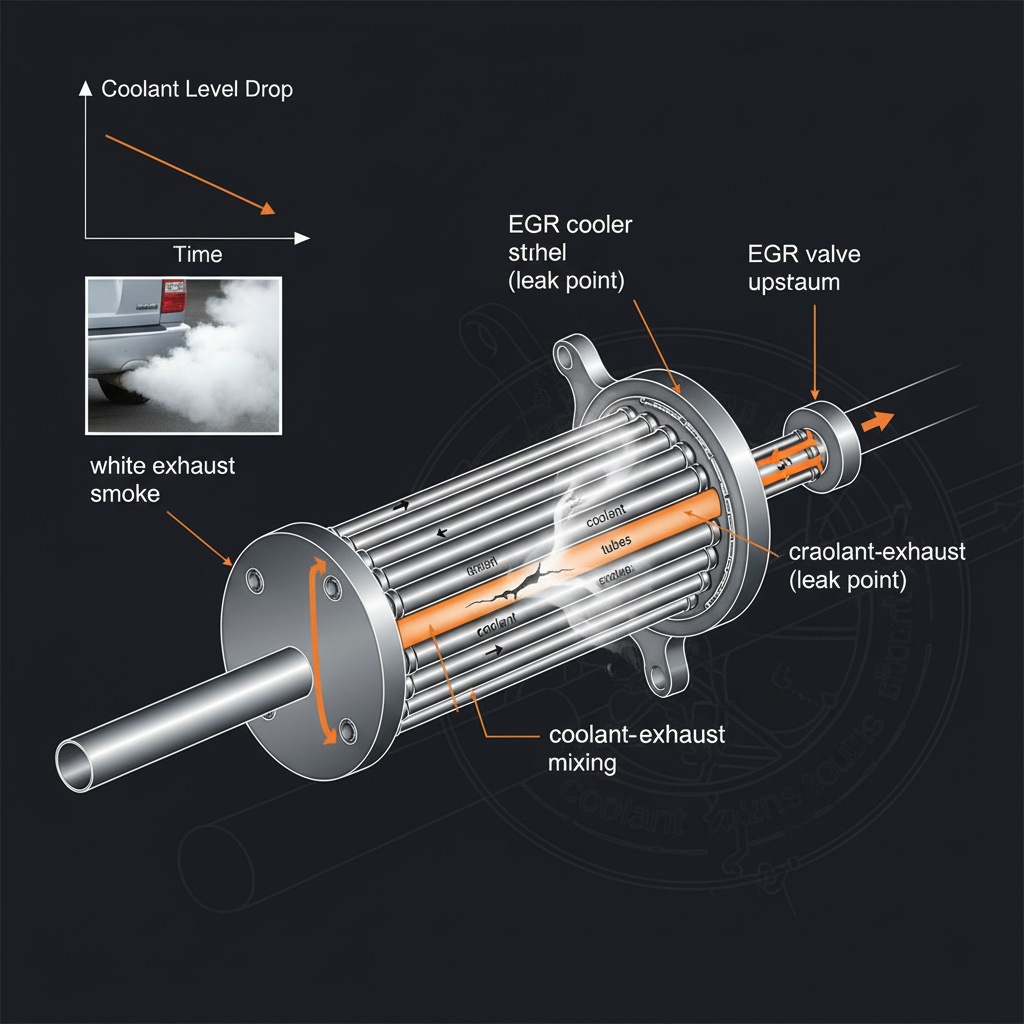
EGR cooler failure is a critical diesel problem that can cause white smoke, coolant loss, high soot, and aftertreatment damage. When the cooler cracks or plugs, exhaust gas and coolant mix in ways that destroy reliability. This guide gives you a structured way to confirm cooler failure and protect the engine.
Why This Matters
- ▸ Cooler failure can lead to rapid coolant loss and overheating — pressure test before anything else.
- ▸ Coolant in the exhaust damages the DPF and SCR catalyst — an expensive cascade failure.
- ▸ Plugged coolers increase EGR temps and soot production across all load ranges.
- ▸ Misdiagnosed cooler issues lead to repeat failures and high repair cost.
8-Step Diagnostic Flow
Check coolant level and pressure for unexplained loss
A slow coolant loss with no visible external leaks is the most common early sign of EGR cooler failure. Pressure test the cooling system — a failed cooler will show pressure loss. Compare coolant loss rate to normal consumption.
Inspect exhaust for white smoke or steam under load
White smoke from the exhaust, especially under load or at startup, indicates coolant entering the combustion or exhaust stream. EGR cooler failure allows coolant to enter the EGR circuit and eventually the intake manifold.
Perform coolant pressure test with EGR circuit isolated
If possible, isolate the EGR cooler from the cooling circuit and pressure test each section separately. A cooler that holds pressure when isolated but fails when connected confirms the cooler as the leak source.
Check EGR cooler for external leaks and staining
Inspect the EGR cooler housing and connections for coolant staining, white residue, or corrosion. External leaks are less common than internal failures but easier to identify. Check all coolant connections at the cooler.
Measure EGR outlet temps vs expected values
SPN 412 (EGR temperature). A failed cooler that is not cooling EGR gas will show elevated EGR outlet temperatures. Compare actual EGR outlet temp to expected values — high temps with normal EGR flow = cooler not functioning.
Inspect DPF and SCR for signs of coolant contamination
Coolant that enters the exhaust stream coats the DPF and SCR substrate with white residue. Inspect the exhaust piping and aftertreatment components for white deposits. Coolant contamination can require DPF replacement or aggressive cleaning.
Check EGR differential pressure and flow
SPN 411 (EGR differential pressure). A plugged EGR cooler restricts EGR flow and causes high differential pressure. Low EGR flow with the valve commanded open = cooler restriction. Compare differential pressure to expected values.
Verify EGR valve operation matches commanded position
SPN 2791 (EGR valve position). Confirm the EGR valve is operating correctly before concluding the cooler is the only issue. A stuck EGR valve combined with a failing cooler is a common combination on high-mileage engines.
Engine-Specific Notes
Cummins ISX / X15
Certain Cummins platforms have known EGR cooler cracking issues at high mileage. Watch for slow coolant loss with no external leaks — this is the most common presentation. Cummins recommends coolant analysis to detect early cooler failure before symptoms appear.
Detroit DD13 / DD15
Detroit uses a two-stage EGR cooler. Cooler plugging causes high EGR temps and increased soot. White smoke complaints are often tied to cooler leaks on DD15 engines. Check both cooler stages for coolant leakage and restriction.
Paccar MX-13
EGR cooler issues on Paccar frequently cascade into DPF failures due to coolant contamination of the substrate. Check for coolant residue in exhaust piping before condemning the DPF. High-duty cycles accelerate cooler wear.
Volvo / Mack MP8
High-duty cycles and poor coolant maintenance accelerate EGR cooler wear on Volvo platforms. Always verify coolant chemistry and service history. Volvo recommends specific coolant types — incompatible coolant accelerates cooler corrosion.
CAT C13 / C15
EGR cooler failure on CAT can mimic head gasket issues — both cause coolant loss and white smoke. Use isolation testing to differentiate. CAT's EGR cooler bypass valve failure can cause cooler overheating and accelerated failure.
International A26
EGR cooler and valve issues often appear together on International engines. Check both flow and sealing surfaces. A26 engines in high-idle or low-load applications are more prone to cooler plugging from soot accumulation.
DVOM Test Points
| Test | Spec | Note |
|---|---|---|
| EGR temp sensors | Resistance and voltage per OEM spec | Drifted sensor masks cooler failure — verify accuracy before diagnosis |
| Coolant temp sensor | 5 V reference, proper signal per OEM temp chart | Inaccurate coolant temp affects cooling system diagnosis |
| EGR valve position sensor | 0.5–4.5 V sweep across full travel | Verify valve operation before concluding cooler is the only issue |
| Fan clutch and cooling system controls | Per OEM spec if electronically controlled | Verify cooling system is operating at full capacity |
Live Data Parameters to Monitor
Coolant Temperature
Should stabilize at thermostat setpoint — rising temp = cooling system issue
EGR Inlet and Outlet Temps
Outlet should be significantly lower than inlet — high outlet = cooler not cooling
EGR Flow Rate or Differential Pressure
Low flow with valve open = cooler restriction; high DP = plugged cooler
Soot Load and Regen Frequency
Increased soot = EGR not contributing properly to combustion control
NOx Levels Before and After SCR
High NOx = EGR not reducing combustion temps effectively
Related Fault Codes
Frequently Asked Questions
Does white smoke always mean EGR cooler failure?
No. White smoke can also come from injector issues, head gasket failure, or cold operation. EGR cooler failure is one possibility that must be confirmed with pressure testing and coolant loss verification. Always isolate the source before replacing the cooler.
Can coolant in the exhaust ruin the DPF?
Yes. Coolant contamination can coat the DPF substrate, reduce efficiency, and require replacement or aggressive cleaning. If coolant has been entering the exhaust for an extended period, inspect the DPF before returning the vehicle to service.
Should I replace the cooler proactively?
In high-risk platforms or severe duty cycles, some fleets choose proactive replacement at high mileage. But testing should guide the decision — a cooler that passes pressure testing and shows no symptoms does not need replacement.
Master EGR Cooler Diagnosis
The AI Diesel Tech Academy covers EGR cooler failure modes, coolant pressure testing, flow diagnostics, and aftertreatment protection with real-world case studies.
Explore the Academy