
DEF Pump & Dosing Diagnosis
DEF Pump Failure
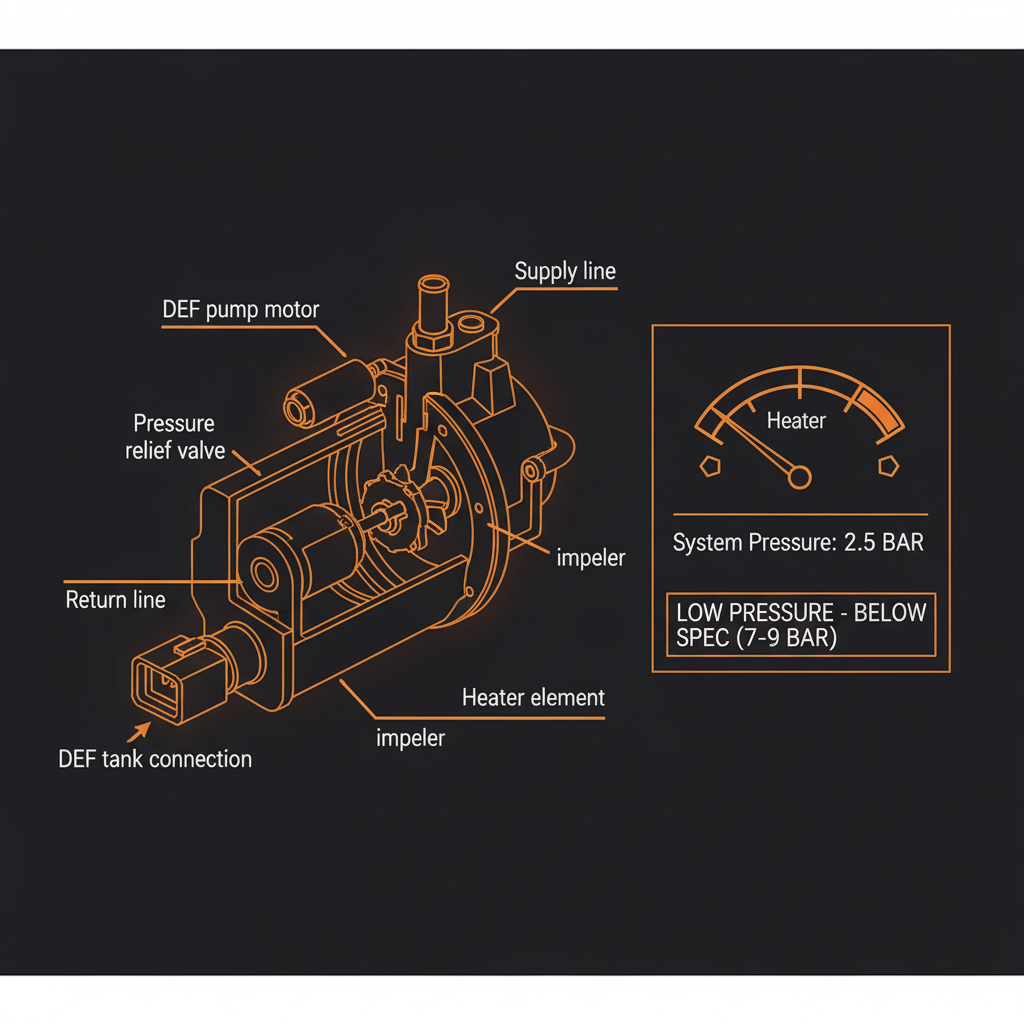
A failed DEF pump stops dosing, breaks SCR efficiency, and quickly triggers derate. When DEF pressure drops or dosing stops, NOx emissions rise and the ECM protects the engine and aftertreatment. This guide covers DEF pressure testing, pump electrical checks, and dosing verification for Cummins, Detroit, Paccar, Volvo, CAT, and International engines.
Why This Matters
- ▸ DEF pump failure means no dosing — SCR efficiency drops and inducement begins.
- ▸ SCR efficiency low leads directly to 5 MPH derate and potential roadside shutdown.
- ▸ DEF system faults can strand trucks far from service — diagnose before dispatch.
- ▸ Misdiagnosed DEF pumps waste time and parts — test before replacing.
8-Step Diagnostic Flow
Check DEF pressure in live data
SPN 4334 (DEF pressure). Compare actual DEF pressure to desired. Low pressure with pump commanded on indicates pump failure, restriction, or electrical issue. Normal pressure with dosing faults points to the doser injector or nozzle.
Verify DEF pump command status
Check pump on/off command and duty cycle in live data. A pump that is not being commanded on when DEF pressure is low indicates an ECM or wiring issue rather than a pump failure. Verify command before testing the pump itself.
Check pump voltage at connector
With key on and pump commanded on, measure voltage at the pump connector. Should be 12–14 V. No voltage with a valid command = wiring or relay issue. Proper voltage with no pump operation = failed pump.
Measure pump current draw during operation
A healthy DEF pump draws 4–6 A under load (verify OEM spec). Low current draw with proper voltage = pump motor failure. High current draw = restriction or seized pump. Use a clamp meter for accurate measurement.
Inspect DEF lines for crystallization or blockage
DEF crystallizes when exposed to air or heat. Inspect all DEF lines, especially at fittings and connections, for white crystalline deposits. Blocked lines cause low pressure even with a functioning pump. Flush or replace blocked lines.
Check DEF filter condition and restriction
A plugged DEF filter restricts flow to the pump and doser. Replace the filter if it has not been serviced recently or if restriction is suspected. Always replace the filter when replacing the pump to prevent repeat failures.
Verify DEF quality and contamination
SPN 3364 (DEF quality). Contaminated DEF (fuel, oil, or water) damages the pump and doser. Test DEF concentration with a refractometer — should be 32.5% urea. Contaminated DEF must be drained and the system flushed before repair.
Check NOx conversion before and after SCR
SPN 3216, 3217 (NOx sensors). Compare upstream and downstream NOx. Poor conversion with proper dosing = SCR catalyst issue. Poor conversion with no dosing = pump or doser failure. Use both data points to isolate the fault.
Engine-Specific Notes
Cummins ISX / X15
DEF pump modules on Cummins often integrate pressure and temperature sensing. Watch for intermittent pressure drops during long regens. Cummins DEF pump failures often present as gradual pressure loss rather than sudden failure.
Detroit DD13 / DD15
DEF pump failures on Detroit often show as low pressure and poor dosing. Check for harness corrosion at the pump connector — Detroit DEF pump connectors are prone to moisture intrusion in certain mounting locations.
Paccar MX-13
DEF crystallization in lines is common in cold climates on Paccar platforms. Line heaters and insulation must be verified before condemning the pump. Cold-soak starts after extended shutdown are a common trigger for crystallization-related faults.
Volvo / Mack MP8
DEF pump and doser coordination is critical on Volvo platforms. Look at dosing quantity vs NOx conversion to isolate pump vs doser vs catalyst issues. Volvo DEF pump failures often coexist with SCR efficiency codes.
CAT C13 / C15
DEF contamination (fuel or oil) quickly damages the pump on CAT engines. Always test DEF quality before replacing components. CAT DEF pump failures in contaminated systems require full system flush and filter replacement.
International A26
DEF pump faults on International often coexist with SCR efficiency codes. Check inducement counters and derate logic to understand how far the system has progressed. A26 DEF systems are sensitive to DEF quality and temperature.
DVOM Test Points
| Test | Spec | Note |
|---|---|---|
| DEF pump supply voltage | 12–14 V at connector with pump commanded on | No voltage with valid command = wiring or relay issue |
| Pump current draw | 4–6 A under load (verify OEM spec) | Low current = motor failure; high current = restriction or seized pump |
| Pressure sensor | 0.5–4.5 V signal, 5 V reference | Out-of-range signal = sensor failure; check for blocked pressure port |
| Line heater circuits | Continuity and proper resistance per OEM spec | Open heater circuit = crystallization risk in cold climates |
Live Data Parameters to Monitor
DEF Pressure (bar/kPa)
Should reach target pressure within seconds of pump command
DEF Pump Command (on/off, duty cycle)
Verify pump is being commanded before testing pump itself
DEF Dosing Rate (ml/min or g/s)
Should match commanded rate — zero during active command = doser issue
DEF Quality (if sensor-equipped)
Should read 32.5% urea — low reading = diluted or contaminated DEF
Upstream NOx (ppm)
Baseline NOx entering SCR — high = combustion or EGR issue
SCR Efficiency %
≥70% at cruise — low efficiency with proper dosing = catalyst issue
Related Fault Codes
Frequently Asked Questions
Can a DEF pump fail intermittently?
Yes. Heat, contamination, and electrical issues can cause intermittent pressure drops or dosing failures that only appear under certain conditions — often during extended operation or after heat soak. Intermittent failures are harder to diagnose and may require extended monitoring.
Does low DEF pressure always mean the pump is bad?
No. Blocked filters, crystallized lines, or faulty pressure sensors can mimic pump failure. Always verify restriction and sensor accuracy first. A new pump installed into a restricted system will fail quickly.
Can I bypass the DEF pump to avoid derate?
No. Tampering with DEF systems is illegal in most jurisdictions and will cause long-term damage and compliance issues. The correct repair is to diagnose and fix the DEF system.
Master DEF System Diagnosis
The AI Diesel Tech Academy covers DEF pump testing, dosing logic, SCR efficiency, and NOx sensor interpretation with DVOM procedures and real-world case studies.
Explore the Academy