
P2263 — Turbocharger/Supercharger Boost System Performance
P2263 is a general boost system performance fault indicating the boost control system cannot achieve or maintain desired pressure within limits. System-level approach prevents single-component guessing on a performance code. Treat P2263 as a system code — run the full boost decision tree.
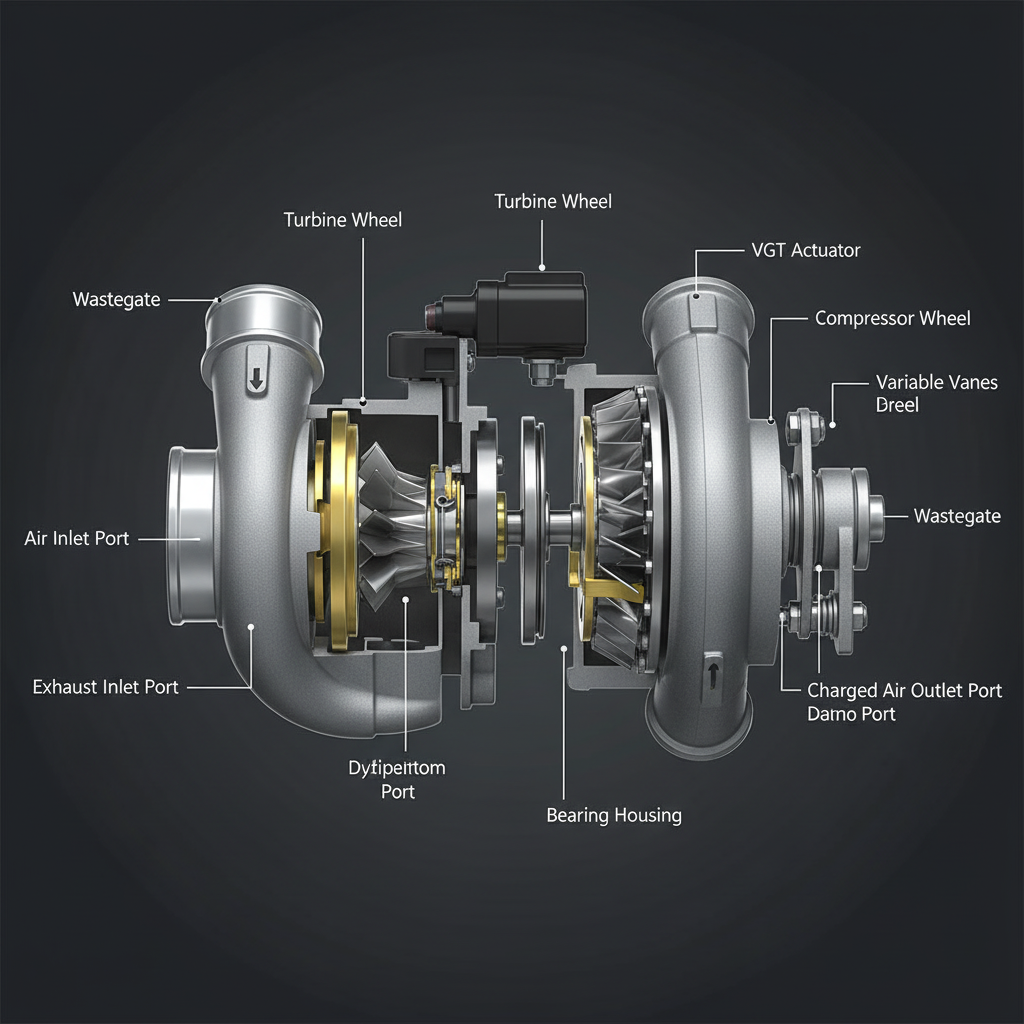
Fault Overview
P2263 is a combination code that can result from charge-air leaks, VGT sticking, MAP issues, oil supply problems, exhaust restriction, or control circuit problems. Start with the easiest high-probability items (leaks and MAP). Document commanded vs actual throughout the diagnostic.
Engine & Platform Coverage
Symptoms
- •P2263
- •boost system performance
- •turbo performance code
- •P2263 diesel
- •boost control fault
Possible Causes
- 1.Charge-air leaks (boots, clamps, intercooler)
- 2.VGT vanes sticking
- 3.MAP sensor bias
- 4.Oil supply restriction to VGT
- 5.Exhaust restriction
- 6.Control circuit problems
Wiring & Circuit Notes
VGT actuator, MAP, and related control circuits.
DVOM Specs & Sensor Tests
Full boost and VGT data correlation. Charge-air decay test. Oil pressure. MAP gauge verification.
Diagnostic Flow — FSM Sequence
AI Diesel Tech enforces this evidence-gate sequence. Each gate must pass before advancing.
5 steps locked behind Technician Mode- 1Step 1 — Graph Commanded vs Actual Boost and VGT Position: Graph commanded vs actual boost and VGT position simultaneously. Identify whether the system is under or over target.
- 2Step 2 — Perform Charge-Air Leak Test: Perform a charge-air pressure decay or smoke test. Leaks are the highest-probability cause.
- 3Step 3 — Verify MAP with Gauge: Verify MAP sensor accuracy with a mechanical gauge.
- 4Step 4 — Check VGT Response and Oil Supply: Command a VGT sweep and verify response. Check oil supply pressure and flow to the turbo.
- 5Step 5 — Inspect for Exhaust Leaks or Restriction: Inspect for exhaust leaks or restriction upstream of the turbo.
- 6Step 6 — Follow the Complete Boost Diagnostic Tree: Follow the complete boost diagnostic tree, addressing each cause in order of probability.
Unlock the full evidence-gated diagnostic sequence, DVOM test steps, and repair procedures in Technician Mode.
Full Diagnostic Access
Verification steps, preventative measures, severity guidance, and legacy comparison are available in Technician Mode.
Typical Repair Costs
Directed by findings — leaks $50–300, VGT service $300–1,500, MAP $80–250, oil supply $100–400, turbo $1,500–3,000+.
Start Diagnosing This Fault Now
AI Diesel Tech walks you through every evidence gate in the correct order. Choose the plan that fits your shop.
Related Systems
Related Fault Codes
Related Sensor Locations
Common Symptoms
Related Articles
AI Diesel Tech — The Technician's Diagnostic Engine
AI Diesel Tech diagnostic logic is built by an ASE Certified Diesel Technician and engineered for professional shop use. Trusted by technicians nationwide — used in shops, fleets, and training programs.
Summary
Use the AI Diesel Tech diagnostic engine to run this code through a structured, evidence-gated sequence and get a confirmed root cause before any parts are replaced.