
Turbo / VGT Diagnosis
Low Boost Diesel
Low boost is a universal diesel failure. This USA-built diagnostic guide covers turbocharger logic, VGT actuator testing, boost sensors, charge air leaks, and EGR contribution for all major engine families worldwide.
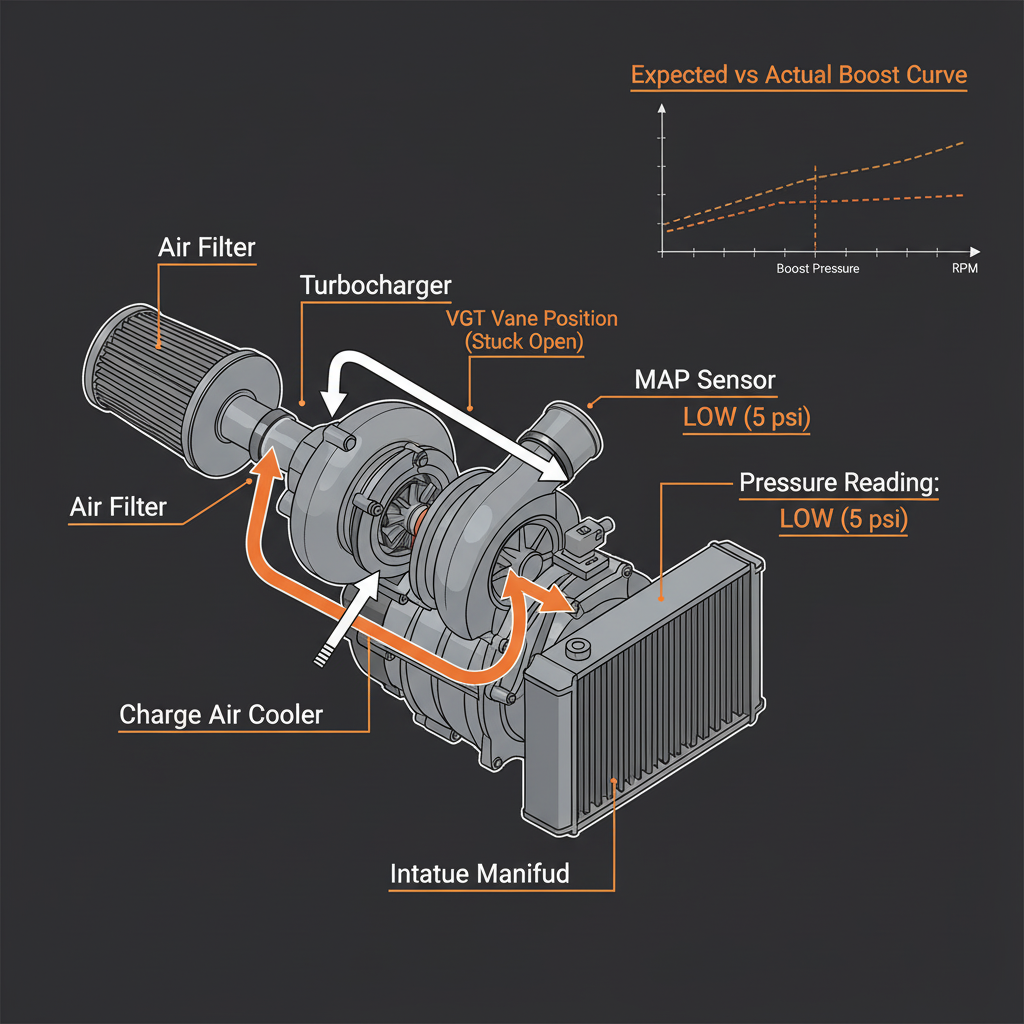
Why This Matters
- ▸ No power. Slow acceleration. Driver complaints about sluggish performance.
- ▸ Low boost leads to derate as the ECM reduces fuel delivery to protect the engine.
- ▸ Unnecessary turbo replacement costs $2,500–$6,000 — most low boost failures are VGT actuator or boost leaks.
- ▸ Built on American turbo diagnostic standards with global engine coverage.
Turbo/VGT Diagnostic Flow
Check boost pressure (MAP)
SPN 102 (intake manifold pressure). Compare desired vs actual boost at WOT. Desired significantly higher than actual = turbo underperformance. Desired matches actual but both low = sensor or calibration issue.
Check VGT actuator
SPN 1189 (VGT actuator position). Command VGT to full closed and full open with scan tool. Actuator should move freely through full range. Sticking actuator = carbon buildup or actuator failure.
Check turbo speed
SPN 103 (turbocharger speed). Low turbo speed at high load = compressor wheel damage, turbine restriction, or bearing failure. High turbo speed with low boost = compressor bypass leak or charge air cooler leak.
Check MAP/MAF sensors
SPN 102 (MAP), SPN 132 (MAF). A biased MAP sensor causes false low boost readings without actual turbo failure. Compare MAP reading to a mechanical boost gauge to verify sensor accuracy.
Check for exhaust leaks
Exhaust leaks before the turbine reduce exhaust energy driving the turbo. Check turbo inlet, manifold gaskets, and EGR connections. A boost smoke test can identify intake leaks after the compressor.
Check for intake leaks
Boost leaks after the compressor (charge air cooler, intercooler piping, intake manifold) cause low boost despite normal turbo operation. Pressurize the intake system to 30 PSI and listen for leaks.
Check EGR contribution
High EGR flow dilutes intake charge and reduces effective boost. SPN 27 (EGR valve position), SPN 411 (EGR differential pressure). Stuck-open EGR valve causes chronic low boost and black smoke.
Engine-Specific Low Boost Patterns
Cummins ISX / X15
VGT actuator carbon buildup is the most common low boost cause on ISX/X15. Check SPN 1189 (VGT position) and command actuator sweep with Insite. Carbon buildup causes slow or no actuator response.
Detroit DD13 / DD15
DD series uses a variable geometry turbo with an electronic actuator. Common low boost: SPN 1189 (VGT), SPN 102 (MAP sensor). DD15 is sensitive to EGR cooler restriction causing high EGR temps and reduced boost.
Paccar MX-13
MX-13 uses a two-stage turbo system on some configurations. Check both turbo stages for boost contribution. Common low boost: charge air cooler leak, VGT actuator, or MAP sensor bias.
Volvo / Mack MP8
Volvo D13 uses a VGT with a separate electronic actuator. Check actuator voltage and position feedback. Common low boost: actuator failure, charge air cooler leak, or EGR valve stuck open.
CAT C13 / C15
CAT uses a VGT on C13/C15. Check SPN 1189 and compare desired vs actual VGT position. CAT engines are sensitive to exhaust restriction — check DPF differential pressure before turbo diagnosis.
International A26
A26 uses a VGT with electronic actuator. Common low boost: VGT actuator, MAP sensor, or charge air cooler leak. Check for active EGR faults that could cause high EGR flow and boost dilution.
DVOM Testing Block
| Test | Spec | Note |
|---|---|---|
| VGT actuator | 12–14V supply, position feedback 0.5–4.5V | Low supply voltage causes actuator sluggishness; out-of-range feedback = actuator or wiring fault |
| MAP sensor | 0.5V at 0 PSI, 4.5V at max boost | Compare to mechanical gauge — biased MAP causes false low boost readings |
| MAF sensor | 0.5–4.5V or frequency signal (engine-specific) | Low MAF reading causes ECM to reduce fuel delivery, compounding low boost symptoms |
| Turbo speed sensor | Frequency signal — verify with oscilloscope | No signal = sensor failure or wiring fault; low frequency = low turbo speed |
Live Data Parameters to Monitor
Boost Pressure (MAP)
Engine-specific; compare desired vs actual at WOT
VGT Position (%)
Should track commanded position within ±5%
Turbo Speed (RPM)
Engine-specific; low at high load = turbo issue
MAF (g/s or lb/min)
Compare to spec at idle and cruise
EGR Flow (%)
Should decrease at high load; stuck high = EGR issue
Boost Desired vs Actual
Desired should match actual within 2–3 PSI
Related Fault Codes
Frequently Asked Questions
How do I know if it's a VGT actuator or a boost leak?
Command the VGT actuator through its full range with a scan tool. If it moves freely and boost is still low, suspect a boost leak. Pressurize the intake system to 30 PSI with the engine off and listen for leaks at charge air cooler connections, intercooler piping, and intake manifold gaskets. If the VGT doesn't move or moves slowly, the actuator or its circuit is the issue.
Can a MAP sensor cause low boost symptoms?
Yes. A biased MAP sensor that reads low will cause the ECM to command more fuel to compensate, but the actual boost is normal. Compare the MAP sensor reading to a mechanical boost gauge connected to the intake manifold. If the mechanical gauge reads higher than the sensor, the sensor is biased low and should be replaced before any turbo diagnosis.
What causes VGT actuator carbon buildup?
Carbon buildup on VGT vanes is caused by oil consumption (worn rings or valve seals), EGR soot deposits, or extended idle operation. The carbon restricts vane movement, causing the actuator to work harder and eventually fail to reach commanded position. Some engines have a VGT cleaning procedure using the scan tool — check OEM service information before condemning the actuator.
Learn Turbo Sensor Testing
The DVOM & Multimeter Fundamentals course covers MAP sensor testing, VGT actuator circuits, and boost system diagnosis.
View DVOM Course