
P0299 — Turbocharger Underboost Condition
P0299 sets when actual boost pressure is significantly below commanded boost for a calibrated time and load. The ECM detects insufficient turbo performance. Mandatory charge-air leak test before any turbo replacement prevents the most common and expensive misdiagnosis — 80% of P0299 cases on late-model diesels are charge-air leaks.
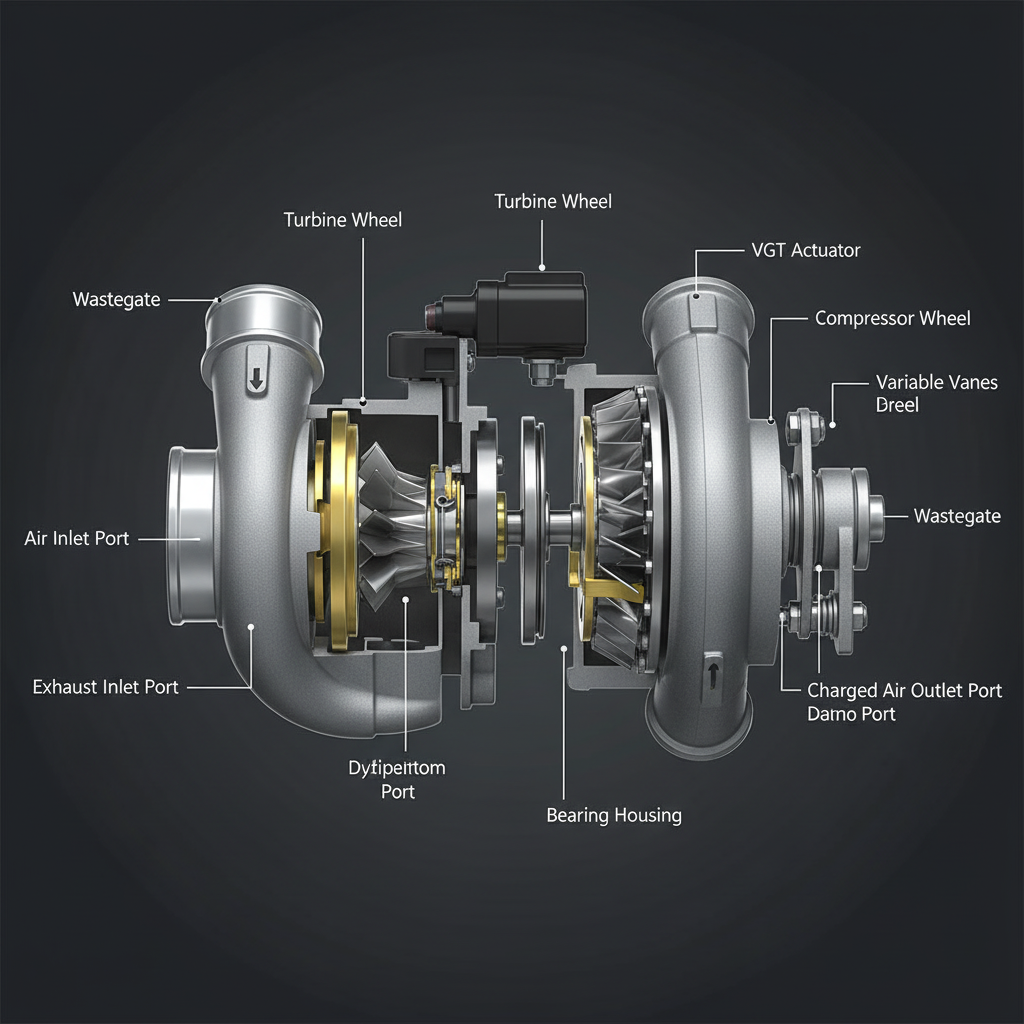
Fault Overview
Charge-air leaks (boots, clamps, intercooler), stuck-open VGT vanes, failed turbo, restricted air filter, MAP sensor bias, exhaust leaks before the turbo, and oil supply issues to the VGT are the primary causes. On Power Stroke 6.7 the CAC boots are a known failure point. After repairing leaks, clear adaptive values if the platform supports it.
Engine & Platform Coverage
Symptoms
- •P0299
- •underboost
- •turbo underboost
- •low boost diesel
- •P0299 Powerstroke
- •P0299 Cummins
- •P0299 Duramax
- •boost leak
Possible Causes
- 1.Charge-air leaks (boots, clamps, intercooler)
- 2.Stuck-open VGT vanes
- 3.Failed turbo
- 4.Restricted air filter
- 5.MAP sensor bias
- 6.Exhaust leaks before turbo
- 7.Oil supply issues to VGT
Wiring & Circuit Notes
VGT actuator circuits and MAP sensor circuits. Voltage drop under load on actuator power and ground.
DVOM Specs & Sensor Tests
Commanded vs actual boost. MAP vs mechanical gauge. VGT position commanded vs actual. Charge-air pressure decay test results.
Diagnostic Flow — FSM Sequence
AI Diesel Tech enforces this evidence-gate sequence. Each gate must pass before advancing.
5 steps locked behind Technician Mode- 1Step 1 — Graph Commanded vs Actual Boost Under Load: Graph commanded vs actual boost pressure under load. Document the deficit and the conditions when it occurs.
- 2Step 2 — Perform Charge-Air Pressure Decay or Smoke Test: Perform a charge-air pressure decay or smoke test. This is the single most important step — 80% of P0299 cases are leaks.
- 3Step 3 — Verify MAP Sensor Accuracy with a Gauge: Verify MAP sensor accuracy with a mechanical gauge. A biased MAP causes the ECM to see false underboost.
- 4Step 4 — Command VGT Sweep and Check Response: Command a VGT sweep and verify the vanes move through their full range. Sticking vanes are a common cause.
- 5Step 5 — Inspect Air Filter and Intake: Inspect the air filter and intake for restriction.
- 6Step 6 — Check Turbo Shaft Play and Oil Supply Only After Leaks and Control Are Eliminated: Check turbo shaft play and oil supply only after charge-air leaks, MAP, and VGT control are proven good.
Unlock the full evidence-gated diagnostic sequence, DVOM test steps, and repair procedures in Technician Mode.
Full Diagnostic Access
Verification steps, preventative measures, severity guidance, and legacy comparison are available in Technician Mode.
Typical Repair Costs
Replace CAC boots and clamps $50–300; repair intercooler $200–800; free or replace VGT $300–1,500; replace turbo if mechanically failed $1,500–3,000+.
Start Diagnosing This Fault Now
AI Diesel Tech walks you through every evidence gate in the correct order. Choose the plan that fits your shop.
Related Systems
Related Fault Codes
Related Sensor Locations
Common Symptoms
Related Articles
AI Diesel Tech — The Technician's Diagnostic Engine
AI Diesel Tech diagnostic logic is built by an ASE Certified Diesel Technician and engineered for professional shop use. Trusted by technicians nationwide — used in shops, fleets, and training programs.
Summary
Use the AI Diesel Tech diagnostic engine to run this code through a structured, evidence-gated sequence and get a confirmed root cause before any parts are replaced.