
2017–2021 GM Duramax L5P Fuel Pressure Control Deviations
L5P pressure deviations need sensor, supply, and control proof before pump replacement. The ordered pressure-control tree reduces pump misdiagnosis — maintenance-related filter restriction and contamination events are the most common entry points on this platform.
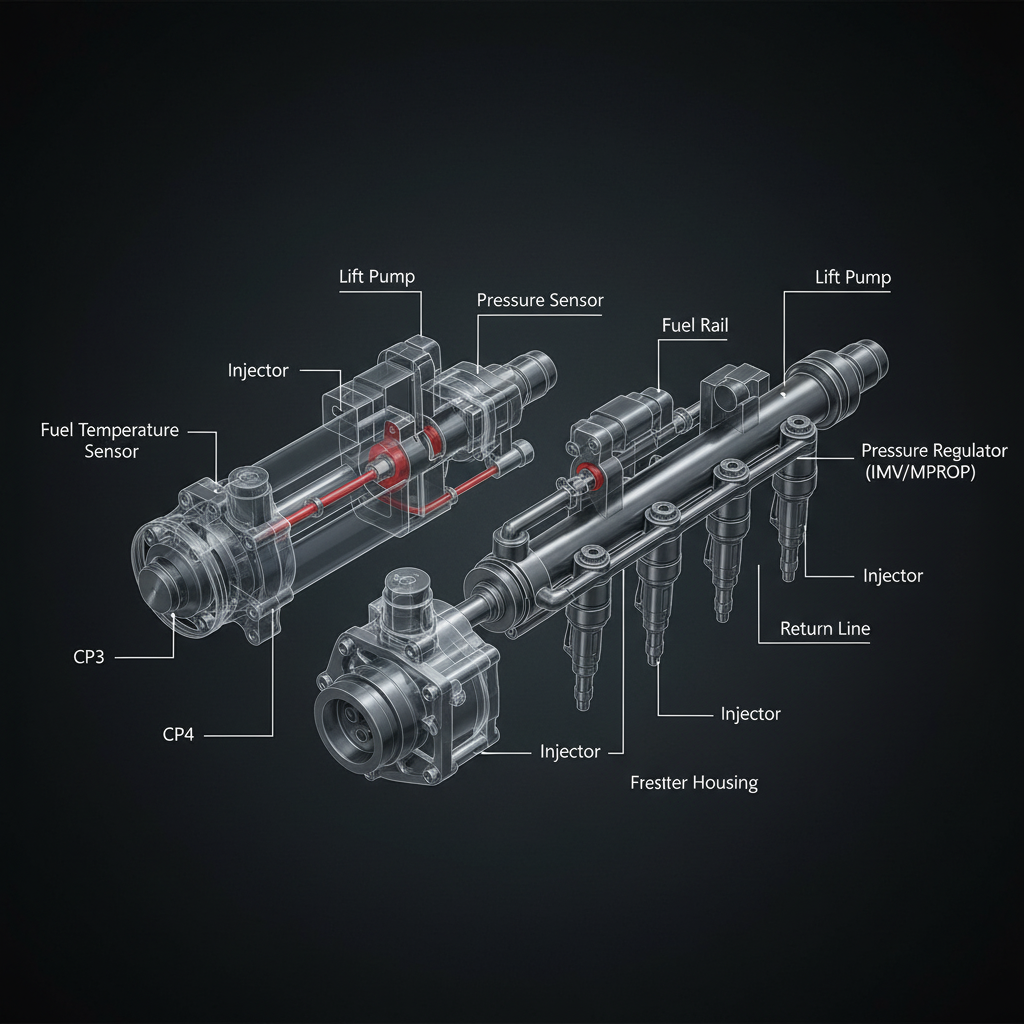
Fault Overview
The Duramax L5P fuel pressure control deviation pattern covers P0087, P0088, P0191, and related rail pressure codes. Filter restriction, supply issues, pressure control valve problems, FRP sensor faults, injector leak contribution, and HP pump wear are the primary causes. Maintenance-related filter restriction and contamination events are documented patterns — a restricted fuel filter produces the same low-rail symptom as a failed HP pump. Guessing the HP pump without proving sensor, supply, and control integrity is the most expensive misdiagnosis on L5P pressure complaints.
Engine & Platform Coverage
Symptoms
- •L5P low fuel pressure fault active
- •L5P P0087 fuel rail pressure low
- •Duramax hard start hot or cold
- •L5P rail pressure fluctuation
- •Long crank before start
- •Power loss under load from low rail pressure
Possible Causes
- 1.Filter restriction — restricted fuel filter from maintenance interval or contamination
- 2.Supply issues — lift pump weakness or suction leak
- 3.Pressure control valve problems — control valve not responding to ECM command
- 4.FRP sensor faults — sensor bias or circuit fault producing false low-rail codes
- 5.Injector leak contribution — worn injectors contributing to low rail pressure
- 6.HP pump wear — pump wear after other causes are eliminated
Diagnostic Flow — FSM Sequence
AI Diesel Tech enforces this evidence-gate sequence. Each gate must pass before advancing.
6 steps locked behind Technician Mode- 1Step 1 — Sensor and 5V Proof: Verify FRP sensor circuit integrity and 5V reference bus health. A sensor circuit fault or 5V bus loading by a companion sensor produces false low-rail codes without any hydraulic problem. Confirm sensor integrity before any hydraulic diagnosis.
- 2Step 2 — Filter and Low-Side Supply Check: Verify fuel filter condition and low-side supply pressure. A restricted fuel filter is the most common cause of L5P pressure deviations. Replace the fuel filter if it is at or beyond the service interval. Verify lift pump pressure meets OEM specification.
- 3Step 3 — Control Response Assessment: Assess pressure control response. Graph actual versus desired rail pressure. If actual pressure lags desired pressure with confirmed supply, the pressure control valve or HP pump is not responding correctly. If actual pressure tracks desired pressure but both are low, the pressure target may be reduced from a protection strategy.
- 4Step 4 — Injector Leak-Off Evaluation: Evaluate injector leak-off contribution. Worn injectors with out-of-spec leak-off allow rail pressure to bleed down faster than the pump can maintain it. Perform OEM return-flow or leak-off test if supply and control are confirmed adequate. Refer to the Injector Return Flow procedure for the full leak-off isolation sequence.
- 5Step 5 — HP Pump Decision: Proceed to HP pump evaluation only after sensor, supply, filter, control, and injector leak-off are confirmed not to be the cause. HP pump replacement is the last step — not the first. Consult current GM service information by VIN for any applicable TSBs before pump replacement.
- 6Step 6 — Hot Restart Assessment: For hot restart complaints, assess residual pressure bleed-down after shutdown. Excessive bleed-down from injector leak-off causes hot restart difficulty from insufficient residual pressure. Confirm whether the complaint is hot-start specific before any pump diagnosis.
- 7Step 7 — Verification: After repair, verify rail pressure meets OEM specification at idle and under load. Confirm hot restart performance is normal. Monitor for return of pressure deviation codes over extended operation.
Unlock the full evidence-gated diagnostic sequence, DVOM test steps, and repair procedures in Technician Mode.
Repair Steps
4 steps locked- 1Replace fuel filter if restriction or contamination is confirmed.
- 2Repair lift pump or suction leak if supply fault is confirmed.
- 3Replace pressure control valve if control fault is confirmed.
- 4Replace outlier injector if leak-off test identifies excessive leak-off.
- 5Replace HP pump only after all upstream causes are eliminated.
- 6Consult current GM service information by VIN for applicable TSBs.
Unlock full diagnostic steps, DVOM tests, and repair procedures.
Full Diagnostic Access
Verification steps, preventative measures, severity guidance, and legacy comparison are available in Technician Mode.
Start Diagnosing This Fault Now
AI Diesel Tech walks you through every evidence gate in the correct order. Choose the plan that fits your shop.
Related Resources
Related Fault Codes
Related Systems
Related Sensor Locations
Common Symptoms
Related Articles
AI Diesel Tech — The Technician's Diagnostic Engine
AI Diesel Tech diagnostic logic is built by an ASE Certified Diesel Technician and engineered for professional shop use. Trusted by technicians nationwide — used in shops, fleets, and training programs.
Summary
L5P pressure deviations need sensor, supply, and control proof before pump replacement. The AI Diesel Tech FSM enforces the ordered pressure-control tree to reduce pump misdiagnosis.