
DEF Dosing Quantity Too High — Performance / Over-Dosing
High dosing quantity is confirmed by checking valve control state when dosing should be off and verifying pressure before component replacement.
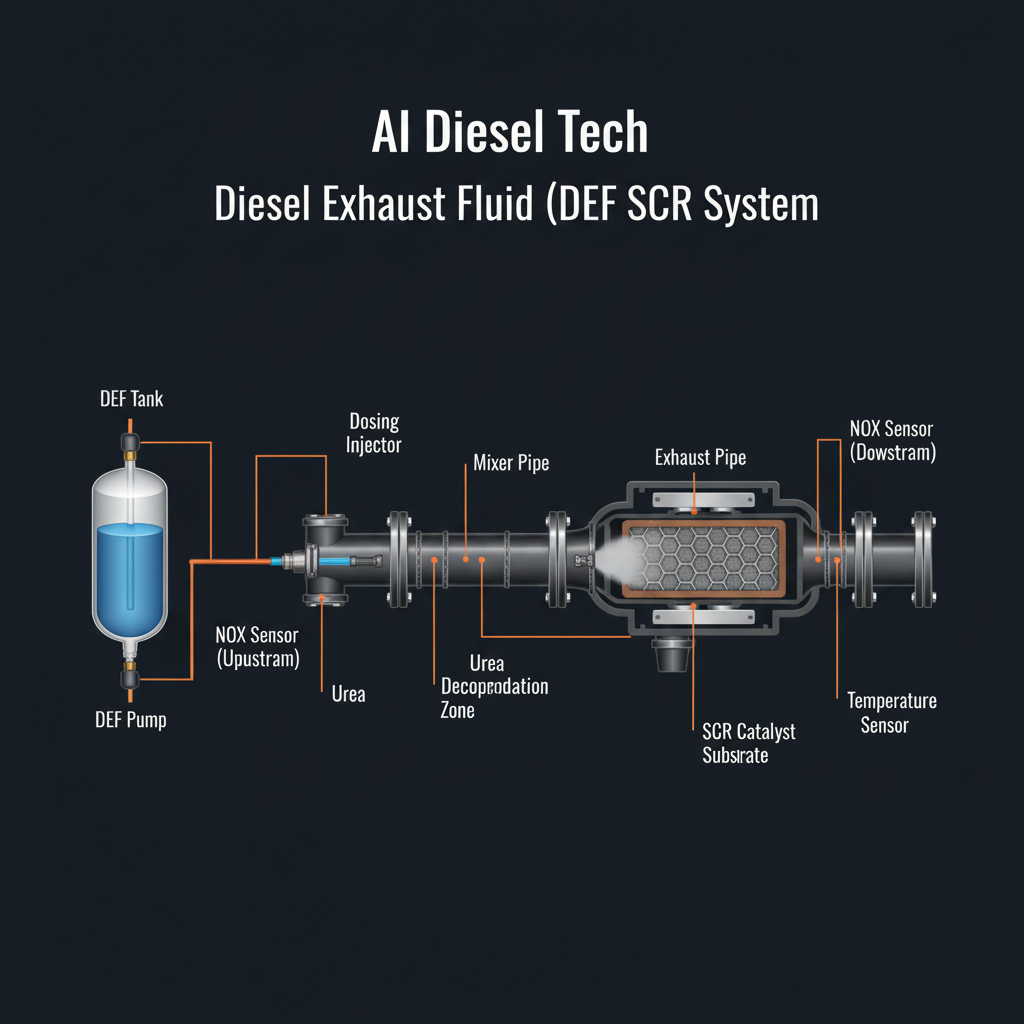
Fault Overview
Performance fault indicating actual DEF quantity exceeds the commanded or expected amount, often detected by ammonia slip, excessive NOx reduction, or direct quantity feedback.
Engine & Platform Coverage
Symptoms
- •DEF over-dosing
- •Dosing quantity high
- •Ammonia slip
- •Excess DEF
- •SCR over-dosing
- •White deposit exhaust
Possible Causes
- 1.Stuck open or leaking dosing valve
- 2.Incorrect pump calibration
- 3.Pressure too high
- 4.Wiring short causing continuous valve operation
- 5.NOx sensor bias causing closed-loop over-command
- 6.Software calibration issue
Wiring & Circuit Notes
Inspect dosing valve control circuit for shorts to ground or power that could keep the valve open. Check for stuck driver conditions.
DVOM Specs & Sensor Tests
Commanded vs actual quantity. Valve current when it should be off. DEF pressure. Downstream NOx or ammonia sensor data if equipped. Visual inspection for excessive white deposits.
Diagnostic Flow — FSM Sequence
AI Diesel Tech enforces this evidence-gate sequence. Each gate must pass before advancing.
6 steps locked behind Technician Mode- 1Step 1 — Monitor Commanded vs Actual Quantity and Valve Control Status: Monitor commanded vs actual quantity and valve control status. Stuck-open dosing valves and NOx sensor bias are common over-dosing causes.
- 2Step 2 — Check Valve Current When Dosing Should Be Inactive: Check valve current when dosing should be inactive. Any current flow when the valve is commanded off confirms a stuck valve or shorted control circuit.
- 3Step 3 — Inspect Dosing Valve for Leakage or Sticking: Inspect dosing valve for leakage or sticking. Over-dosing produces ammonia slip and visible crystallization around the exhaust.
- 4Step 4 — Verify DEF Pressure is Not Excessive: Verify DEF pressure is not excessive. High pressure combined with a partially stuck valve amplifies over-dosing.
- 5Step 5 — Evaluate NOx Sensor Rationality: Evaluate NOx sensor rationality. A biased upstream NOx sensor can cause the ECM to over-command quantity in closed-loop control.
- 6Step 6 — Perform OEM Quantity Test: Perform OEM quantity test to quantify the over-dosing before replacing components.
- 7Step 7 — Repair Valve or Circuit Before Replacing Other Components: Repair valve or circuit before replacing other components.
Unlock the full evidence-gated diagnostic sequence, DVOM test steps, and repair procedures in Technician Mode.
Full Diagnostic Access
Verification steps, preventative measures, severity guidance, and legacy comparison are available in Technician Mode.
Typical Repair Costs
Replace stuck dosing valve $200–500; repair control circuit short $100–300; correct pressure control $100–400; address NOx sensor bias $300–700; software update if applicable. Total $200–700.
Start Diagnosing This Fault Now
AI Diesel Tech walks you through every evidence gate in the correct order. Choose the plan that fits your shop.
Related Systems
Related Fault Codes
Related Sensor Locations
Common Symptoms
Related Articles
AI Diesel Tech — The Technician's Diagnostic Engine
AI Diesel Tech diagnostic logic is built by an ASE Certified Diesel Technician and engineered for professional shop use. Trusted by technicians nationwide — used in shops, fleets, and training programs.
Summary
Use the AI Diesel Tech diagnostic engine to run this code through a structured, evidence-gated sequence and get a confirmed root cause before any parts are replaced.