
Combustion Diagnosis
Excessive Black Smoke
Excessive black smoke indicates poor combustion, airflow restriction, injector over-fueling, or turbo failure on diesel trucks worldwide. This USA-built diagnostic guide covers smoke root causes and global engine behavior for all major diesel platforms.
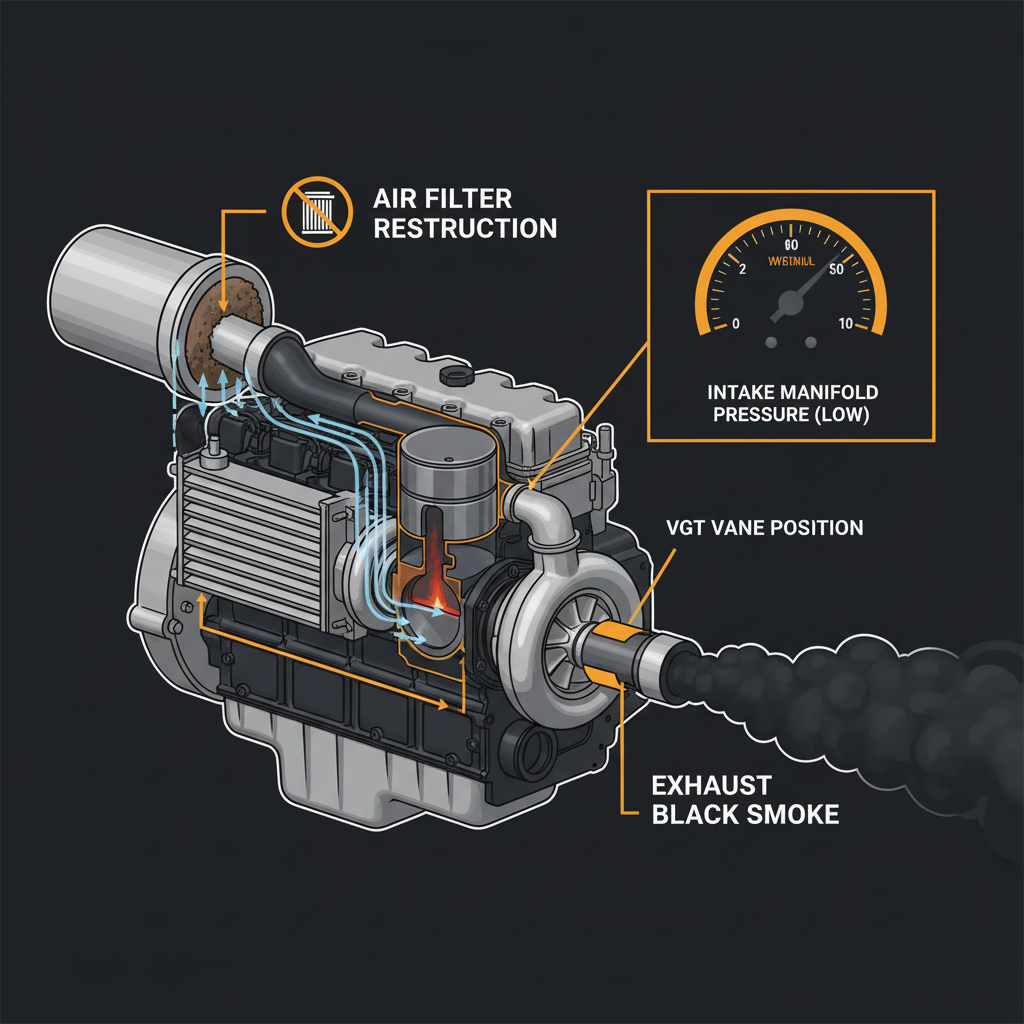
Why This Matters
- ▸Black smoke damages the DPF — unburned carbon loads the substrate and causes premature plugging.
- ▸Heavy smoke at acceleration = turbo lag or VGT failure — the engine is over-fueling before boost builds.
- ▸Continuous black smoke at idle = injector over-fueling or EGR stuck open — diagnose before the DPF is destroyed.
- ▸Built on USA diesel diagnostic standards with global engine coverage.
Black Smoke Diagnostic Flow
Check MAP/MAF
Black smoke is the result of rich combustion — too much fuel for the available air. The first test is airflow: verify MAP signal voltage (1.0–1.5V at idle, rising with boost) and MAF frequency (2,000–4,000 Hz at idle). A low MAP or MAF reading causes the ECM to under-estimate available air and over-fuel. Check for intake leaks before condemning the sensor — a boost leak causes low MAP with correct mechanical boost.
Check boost pressure
Low boost causes rich combustion and black smoke at acceleration. Verify boost pressure with a mechanical gauge at the intake manifold. If boost is low, diagnose the turbo and VGT before condemning the MAP sensor. A VGT stuck open causes low boost at all loads — heavy black smoke at acceleration that clears at cruise. A clogged intercooler causes low boost at high load — check intercooler restriction.
Check injector balance
An injector stuck open or with high return flow over-fuels its cylinder, causing black smoke from that cylinder. Check balance rates — a negative balance rate on one cylinder (ECM reducing fuel) indicates that injector is over-fueling. Perform a return flow test — high return from one injector = worn needle or tip failure causing over-fueling.
Check return flow
High injector return flow from all injectors indicates low FRP causing over-fueling, or a worn injector set. Perform a return flow test at idle and at 1,000 RPM. Compare each injector's return volume. High return from all injectors = low FRP — diagnose the fuel supply system before condemning the injectors. High return from one injector = that injector is the cause of the smoke.
Check EGR flow
A stuck-open EGR valve dilutes intake air with exhaust gas, reducing combustion efficiency and causing black smoke. Check EGR valve position and flow rate on the scan tool — EGR flow should be near zero at idle and moderate at cruise. A stuck-open EGR valve causes continuous black smoke at all loads. Inspect the EGR valve for carbon buildup before condemning it.
Check turbo/VGT
A failing turbo or stuck VGT causes low boost that results in rich combustion and black smoke. Check turbo speed (if available) and VGT actuator position. A VGT actuator that is stuck or slow to respond causes black smoke at acceleration — the engine over-fuels before boost builds. Check VGT actuator voltage and response time before condemning the turbo.
Check fuel quality
Poor fuel quality, water contamination, or high biodiesel content causes incomplete combustion and black smoke. Check fuel color and odor. Dark or cloudy fuel = contamination. High biodiesel blends (above B20) cause increased soot in cold weather. If fuel quality is suspect, drain the tank and refuel with quality diesel before performing further diagnosis.
Engine-Specific Black Smoke Patterns
Cummins ISX / X15
Cummins X15 black smoke at acceleration is most commonly caused by VGT actuator failure or low boost. Check VGT actuator response before diagnosing injectors. Cummins X15 black smoke at idle is most commonly caused by EGR valve carbon buildup or injector balance rate faults. Check balance rates and EGR flow before condemning injectors.
Detroit DD13 / DD15
Detroit DD15 black smoke is commonly caused by EGR valve carbon buildup or VGT actuator failure. Detroit uses a two-stage turbo on some platforms — verify both stages are functioning before diagnosing airflow sensors. Detroit DD15 injector solenoid failures cause black smoke on one cylinder — perform a cylinder contribution test.
Paccar MX-13
MX-13 black smoke is commonly caused by VGT actuator failure or MAP sensor contamination. MX VGT actuator failures are common at high mileage — check actuator response before diagnosing the turbo. MX EGR cooler failures cause coolant contamination of the intake — check for white smoke and coolant loss alongside black smoke.
Volvo / Mack MP8
Volvo D13 black smoke is commonly caused by EGR valve carbon buildup or VGT actuator failure. Volvo D13 EGR valve carbon buildup is common at high mileage — clean the EGR valve before condemning it. Volvo D13 black smoke at cold start that clears when warm = EGR valve stuck open at cold start.
CAT C13 / C15
CAT C15 black smoke is commonly caused by low boost from VGT failure or injector over-fueling. CAT uses HEUI injectors on older platforms — HEUI black smoke is caused by high ICP (injection control pressure) causing over-fueling. Common rail C15 black smoke is caused by injector return flow or low boost. Check ICP on HEUI platforms first.
International A26
A26 shares Cummins black smoke diagnostic logic. Follow Cummins VGT and injector procedure. A26 is sensitive to fuel quality — high biodiesel blends cause black smoke in cold weather. Check fuel quality before diagnosing VGT or injectors on A26 platforms.
DVOM Testing Block
| Test | Spec | Note |
|---|---|---|
| MAP sensor signal voltage | 1.0–1.5V at idle; rises with boost | Stuck low = sensor fault or intake leak causing low MAP reading |
| VGT actuator voltage | 12V supply; 0–5V control signal | No control signal = ECM output failure; stuck actuator = VGT fault |
| EGR valve position sensor | 0.5–4.5V signal range | Stuck at 4.5V = EGR stuck open causing smoke from air dilution |
| Injector solenoid resistance | Per OEM spec (typically 0.3–2 Ω) | Low resistance = shorted coil causing over-fueling |
Live Data Parameters to Monitor
Boost Pressure (SPN 102)
Low boost at acceleration = turbo/VGT cause of smoke
MAP Signal Voltage
1.0–1.5V at idle — low MAP = intake leak or sensor fault
EGR Flow Rate
Near zero at idle — high EGR at idle = stuck-open EGR valve
Balance Rates
Negative balance rate on one cylinder = that injector over-fueling
Injection Quantity
High quantity on one cylinder = injector stuck open or high return flow
FRP Actual vs Desired
Low FRP = all injectors over-fueling from insufficient rail pressure
Related Fault Codes
Frequently Asked Questions
What causes excessive black smoke on a diesel truck?
Black smoke is caused by rich combustion — too much fuel for the available air. The most common causes in order: (1) Low boost from VGT failure or stuck actuator — the engine over-fuels before boost builds at acceleration; (2) EGR valve stuck open — diluting intake air with exhaust gas; (3) Injector over-fueling from worn needle or high return flow; (4) MAP/MAF sensor fault — ECM under-estimating available air; (5) Intake leak — boost escaping before reaching the cylinder; (6) Poor fuel quality or high biodiesel content.
Is black smoke at acceleration normal on a diesel?
A brief puff of black smoke at hard acceleration is normal on older diesel engines without modern aftertreatment. On modern EPA10+ engines with DPF and SCR, any visible black smoke is abnormal and indicates a fault. Continuous black smoke at any load is always abnormal and indicates a diagnostic issue. Modern diesel engines with properly functioning aftertreatment should produce no visible smoke under normal operating conditions.
Can black smoke damage the DPF?
Yes. Black smoke is unburned carbon that loads the DPF. Continuous black smoke from an injector or EGR fault causes rapid DPF loading — a DPF that normally requires regeneration every 500 miles may require regen every 50 miles with a significant smoke-producing fault active. If the DPF loads faster than the regen system can clear it, the DPF plugs completely and requires replacement. Diagnose and repair the smoke source before the DPF is destroyed.
Learn Combustion Diagnosis
The DVOM & Multimeter Fundamentals course covers injector testing, airflow sensor diagnosis, and turbo actuator testing.
View DVOM Course