
Temperature Sensor Diagnosis
Coolant Temp Sensor Problems
Coolant temperature sensor failures cause hard starts, poor fuel economy, high soot, and derates on diesel trucks worldwide. This USA-built diagnostic guide covers temperature logic, regen interaction, and injection correction for all major diesel platforms.
Why This Matters
- ▸Incorrect coolant temp readings disrupt injection timing, cold-start enrichment, and DPF regen logic.
- ▸A stuck-cold reading causes the ECM to over-fuel indefinitely — high soot, DPF plugging, and injector wear follow.
- ▸A stuck-hot reading prevents cold-start enrichment — hard starts in cold climates and rough idle until warm.
- ▸Built on USA diesel diagnostic standards with global engine coverage.
Coolant Temp Sensor Diagnostic Flow
Check sensor resistance
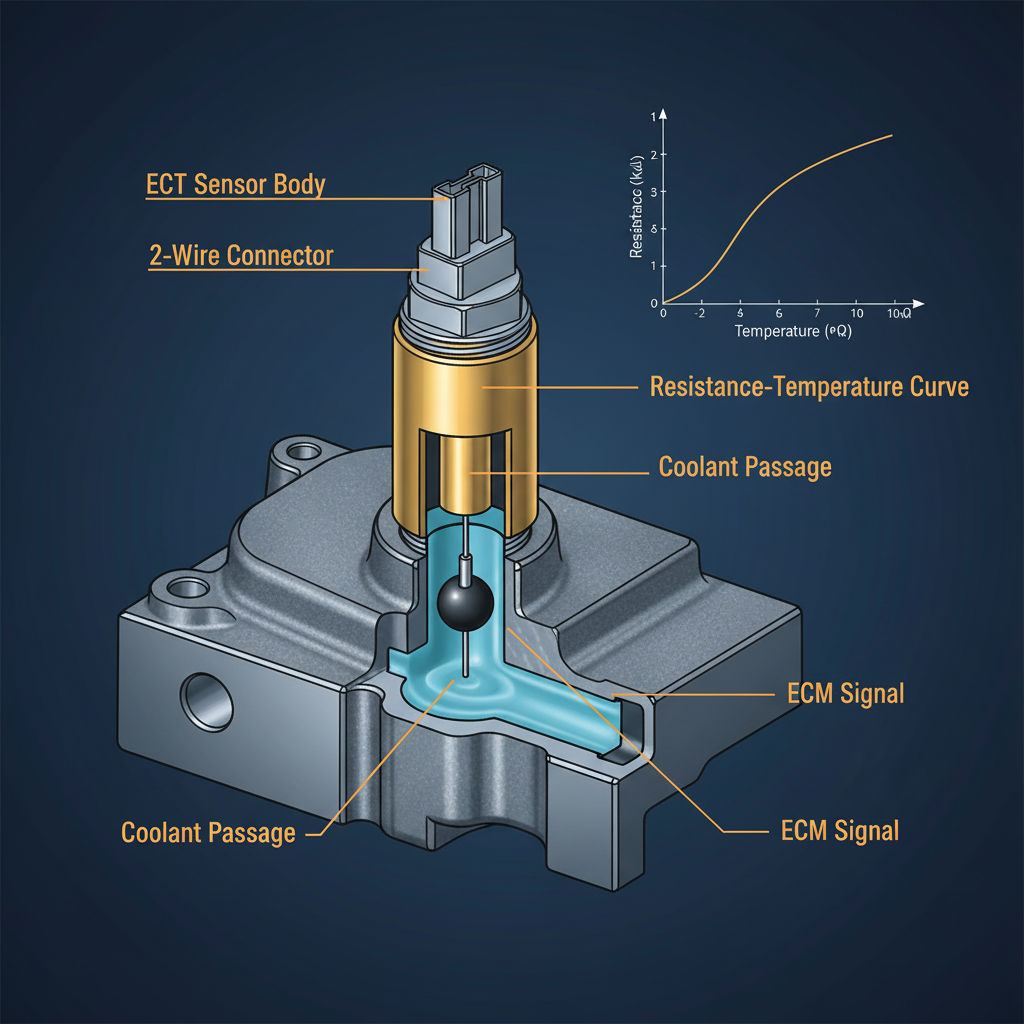
Coolant temp sensors are NTC (Negative Temperature Coefficient) thermistors — resistance decreases as temperature increases. At 32°F (0°C): ~7,000–10,000 Ω. At 68°F (20°C): ~2,500–3,500 Ω. At 212°F (100°C): ~180–250 Ω. Measure resistance with the sensor disconnected and compare to the OEM resistance/temperature chart. A sensor that reads open circuit or short circuit at any temperature = failed sensor.
Check sensor voltage
The ECM supplies a 5V reference through a pull-up resistor. The sensor resistance creates a voltage divider — signal voltage rises as temperature drops (sensor resistance rises). At cold start: signal voltage ~3.5–4.5V. At operating temp: signal voltage ~1.0–2.0V. A signal stuck at 0.1V = short circuit (sensor or wiring). A signal stuck at 4.9V = open circuit (sensor or wiring). Verify signal voltage matches the resistance/temperature curve.
Check coolant flow
A sensor that reads correctly but the engine overheats = coolant flow restriction, not a sensor fault. Check coolant level, thermostat operation, and water pump function. A sensor that reads high temperature with correct coolant level and flow = sensor failure or air pocket near the sensor. Bleed the cooling system before condemning the sensor.
Check thermostat operation
A stuck-open thermostat causes the engine to run cold — the coolant temp sensor reads low because the engine never reaches operating temperature. The ECM responds with cold-start enrichment indefinitely, causing high soot, poor fuel economy, and DPF loading. Verify thermostat operation by monitoring coolant temp rise rate from cold start — a stuck-open thermostat causes slow, incomplete warm-up.
Check EGR contribution
The ECM uses coolant temperature to control EGR flow. A stuck-cold reading causes the ECM to reduce EGR flow (cold-start strategy), which increases NOx emissions and may trigger aftertreatment faults. A stuck-hot reading causes the ECM to enable full EGR flow before the engine is warm, causing rough idle and high soot at cold start.
Check regen capability
DPF regeneration requires the engine to be at operating temperature. A stuck-cold coolant temp reading prevents regen from initiating — the DPF loads with soot until a forced regen is required. If the DPF is loading faster than normal and the coolant temp sensor reads low, verify the sensor before performing a forced regen.
Check fuel system contribution
Cold-start fuel enrichment is controlled by coolant temperature. A stuck-cold reading causes the ECM to maintain cold-start enrichment indefinitely — high fuel consumption, high soot, and injector coking follow. A stuck-hot reading prevents cold-start enrichment — hard starts in cold climates and rough idle until the engine warms up naturally.
Engine-Specific Temp Sensor Patterns
Cummins ISX / X15
SPN 110 (coolant temp). Cummins X15 uses two coolant temp sensors — one for ECM control and one for the gauge/warning system. Verify which sensor is setting the fault before replacing. Cummins coolant temp sensor resistance spec at 68°F (20°C) is 2,500–3,500 Ω. Cummins coolant temp sensor failures are common at high mileage — the sensor tip corrodes in the coolant.
Detroit DD13 / DD15
Detroit uses a coolant temp sensor and an oil temp sensor. Detroit coolant temp sensor failures often present as intermittent hard starts in cold weather — the sensor reads warm when the engine is cold. Detroit coolant temp sensor resistance spec at 68°F (20°C) is 2,000–3,000 Ω. Check the sensor connector for corrosion before condemning the sensor.
Paccar MX-13
MX-13 uses a coolant temp sensor near the thermostat housing. MX coolant temp sensor failures are common near the thermostat housing where the sensor is exposed to coolant flow turbulence. MX coolant temp sensor resistance spec at 68°F (20°C) is 2,500–3,500 Ω. Check for coolant leaks at the sensor threads before condemning.
Volvo / Mack MP8
Volvo D13 uses a coolant temp sensor and a coolant level sensor. Volvo coolant temp sensor failures are common in cold climates — the sensor tip cracks from thermal cycling. Volvo coolant temp sensor resistance spec at 68°F (20°C) is 2,000–3,000 Ω. Check coolant condition — degraded coolant accelerates sensor tip corrosion.
CAT C13 / C15
CAT uses a coolant temp sensor and an aftercooler coolant temp sensor. CAT coolant temp sensor failures are common at high mileage. CAT coolant temp sensor resistance spec varies by model — consult service data. CAT coolant temp sensor failures often present as DPF loading faster than normal — the ECM cannot initiate regen without correct temp data.
International A26
A26 shares Cummins coolant temp sensor architecture. Follow Cummins coolant temp sensor logic. A26 coolant temp sensor failures are less common than Cummins but still occur at high mileage. Check coolant condition — A26 is sensitive to coolant degradation causing sensor tip corrosion.
DVOM Testing Block
| Test | Spec | Note |
|---|---|---|
| Sensor resistance at ambient | 2,500–3,500 Ω at 68°F (20°C) | Compare to OEM resistance/temperature chart — open = failed sensor |
| Sensor signal voltage (cold) | 3.5–4.5V at cold start | Stuck at 0.1V = short circuit; stuck at 4.9V = open circuit |
| Sensor signal voltage (warm) | 1.0–2.0V at operating temp | Verify signal tracks temperature rise during warm-up |
| Harness continuity | <1 Ω from sensor to ECM pin | High resistance = corroded connector or chafed harness |
Live Data Parameters to Monitor
Coolant Temperature (SPN 110)
Should rise steadily from cold start — stuck reading = sensor fault
Warm-up Rate
Should reach operating temp (180–200°F) within 10–15 min — slow warm-up = stuck-open thermostat
EGR Flow Rate
Should be near zero until operating temp — high EGR at cold start = stuck-cold sensor reading
DPF Regen Status
Regen requires operating temp — no regen with low coolant temp reading = sensor fault
Injection Quantity
Cold-start enrichment should decrease as temp rises — stuck enrichment = stuck-cold sensor
Fuel Consumption
High fuel consumption at operating temp = stuck-cold sensor causing over-fueling
Related Fault Codes
Frequently Asked Questions
What are the symptoms of a bad coolant temp sensor?
Common symptoms: (1) Hard start in cold weather — the sensor reads warm when the engine is cold, preventing cold-start enrichment; (2) Poor fuel economy — the sensor reads cold when the engine is warm, causing the ECM to maintain cold-start enrichment; (3) High soot and DPF loading — over-fueling from stuck-cold reading; (4) No DPF regen — the ECM will not initiate regen without correct coolant temp data; (5) Check engine light with SPN 110 faults.
How do I test a coolant temp sensor with a DVOM?
Disconnect the sensor and measure resistance across the two terminals. Compare the reading to the OEM resistance/temperature chart at the current ambient temperature. At 68°F (20°C), most diesel coolant temp sensors read 2,500–3,500 Ω. An open circuit (infinite resistance) or short circuit (near zero resistance) = failed sensor. If resistance is within spec, reconnect the sensor and measure signal voltage at the ECM connector — should be 3.5–4.5V cold and 1.0–2.0V at operating temp.
Can a bad coolant temp sensor cause a no-start?
Rarely, but yes. If the coolant temp sensor reads extremely hot (stuck at maximum temperature), the ECM may reduce or eliminate cold-start enrichment, making the engine very difficult to start in cold weather. More commonly, a bad coolant temp sensor causes hard starts rather than complete no-starts. If the engine cranks but will not start in cold weather, check the coolant temp sensor signal voltage — it should be 3.5–4.5V at cold ambient temperature.
Learn Temperature Sensor Testing
The DVOM & Multimeter Fundamentals course covers NTC sensor resistance curves, voltage divider circuits, and harness integrity testing.
View DVOM Course