
2017–2023 Ford F-Series 6.7 Power Stroke Fuel Delivery Path
On 2017–2023 Ford 6.7 Power Stroke, complete the low-pressure supply checks — voltage, pressure, filter, aeration — before any high-pressure pump or injector work.
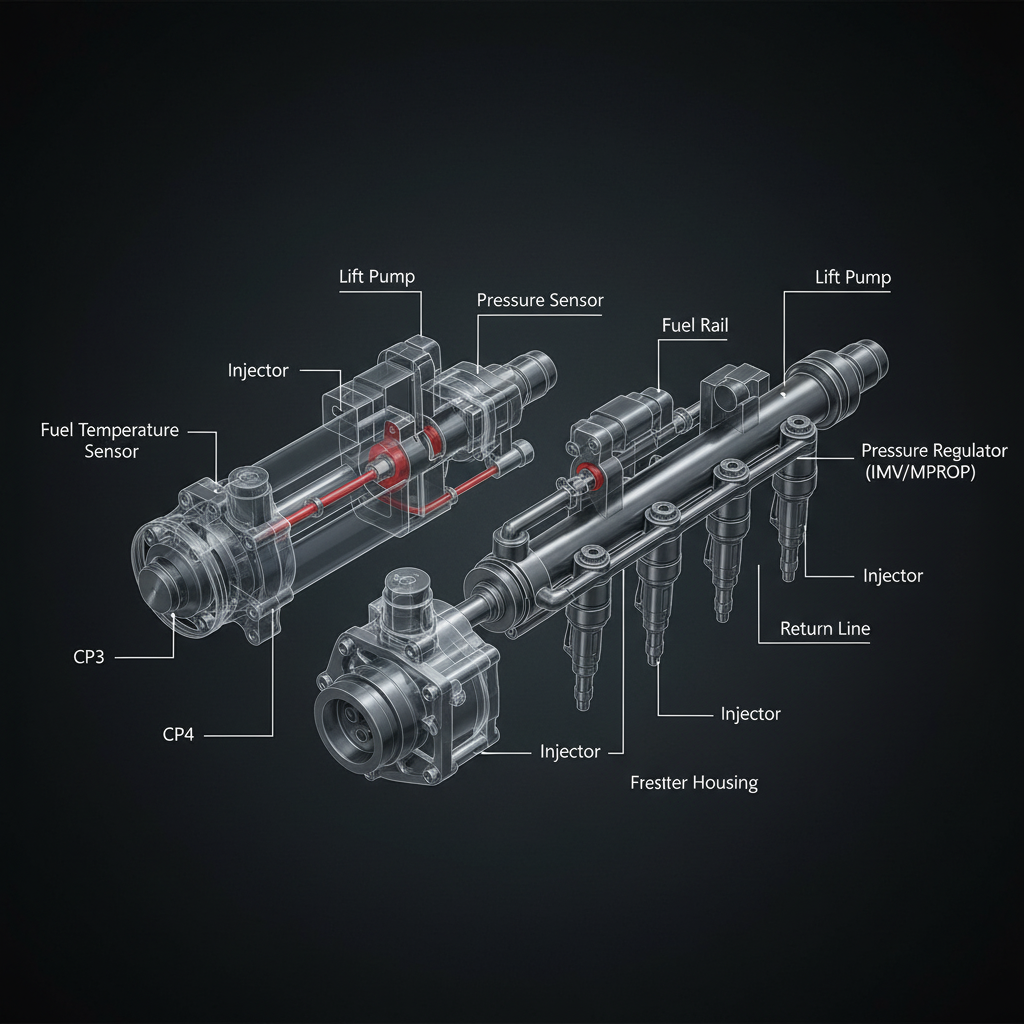
Fault Overview
YMM-specific diagnostic path for low-pressure fuel delivery, fuel conditioning module, lift pump, WIF, and related hard-start or power-loss issues on the 6.7 Power Stroke.
Engine & Platform Coverage
Symptoms
- •Ford 6.7 hard start fuel
- •Power Stroke lift pump fault
- •6.7 fuel conditioning module code
- •Power Stroke WIF code
- •6.7 low fuel pressure
- •Ford diesel aeration after filter service
Possible Causes
- 1.Fuel conditioning module heater or sensor faults
- 2.Lift pump performance or circuit issues
- 3.Filter restriction
- 4.Aeration after filter service
- 5.WIF sensor or actual water
- 6.Tank pickup or transfer pump problems on dual-tank systems
- 7.Voltage drop to the pump
Wiring & Circuit Notes
Inspect fuel conditioning module connector, lift pump power and ground (especially frame grounds), and WIF circuit. Check for corrosion common in this application.
DVOM Specs & Sensor Tests
Supply pressure at the secondary filter or high-pressure pump inlet per Ford specification. Lift pump voltage and current. Module heater resistance. WIF sensor parameters. Aeration observation after service.
Diagnostic Flow — FSM Sequence
AI Diesel Tech enforces this evidence-gate sequence. Each gate must pass before advancing.
6 steps locked behind Technician Mode- 1Step 1 — Verify Fuel Level and Quality: Verify fuel level and quality. Drain WIF if present. Contaminated or low fuel is the starting point.
- 2Step 2 — Check Lift Pump Command, Voltage, and Voltage Drop: Check lift pump command with scan data. Measure voltage and voltage drop at the pump under load. Voltage drop is a frequent cause on this platform.
- 3Step 3 — Measure Supply Pressure: Measure supply pressure at idle, load, and crank per Ford specification. Install mechanical gauge at the secondary filter or high-pressure pump inlet.
- 4Step 4 — Inspect and Differential-Test Filters / Conditioning Module: Inspect and differential-test the filters and conditioning module. Replace if restricted. Check module heater and sensor circuits if codes are present.
- 5Step 5 — Perform Aeration Check: Perform aeration check with clear line if pressure is unstable, especially after filter service. New O-rings and seals must be verified.
- 6Step 6 — Address Dual-Tank Transfer Issues: Address dual-tank transfer issues if applicable. Verify transfer pump operation and supply pressure from each tank.
- 7Step 7 — High-Pressure Diagnosis Only After Low-Pressure Proven: Only after the low-pressure side is proven good, move to high-pressure diagnosis. This prevents the common jump to CP4 or injector replacement.
Unlock the full evidence-gated diagnostic sequence, DVOM test steps, and repair procedures in Technician Mode.
Full Diagnostic Access
Verification steps, preventative measures, severity guidance, and legacy comparison are available in Technician Mode.
Typical Repair Costs
Filter and module service $120–300; lift pump or wiring repair $150–400; suction leak correction $50–150; WIF sensor replacement $40–120; tank transfer pump service $200–500. Total typical $120–600.
Start Diagnosing This Fault Now
AI Diesel Tech walks you through every evidence gate in the correct order. Choose the plan that fits your shop.
Related Systems
Related Sensor Locations
Common Symptoms
Related Articles
AI Diesel Tech — The Technician's Diagnostic Engine
AI Diesel Tech diagnostic logic is built by an ASE Certified Diesel Technician and engineered for professional shop use. Trusted by technicians nationwide — used in shops, fleets, and training programs.
Summary
Use the AI Diesel Tech diagnostic engine to run this code through a structured, evidence-gated sequence and get a confirmed root cause before any parts are replaced.