
SPN 633 FMI 5 — Fuel Injection Control Valve Circuit Open
Fuel injection control valve open-circuit codes are electrical diagnostics first. Hard start or no-start after a control valve connector is not fully locked during pump service is the most documented pattern. The FSM requires circuit proof — coil resistance, continuity, and connector integrity — before the valve or pump assembly is condemned.
Fault Overview
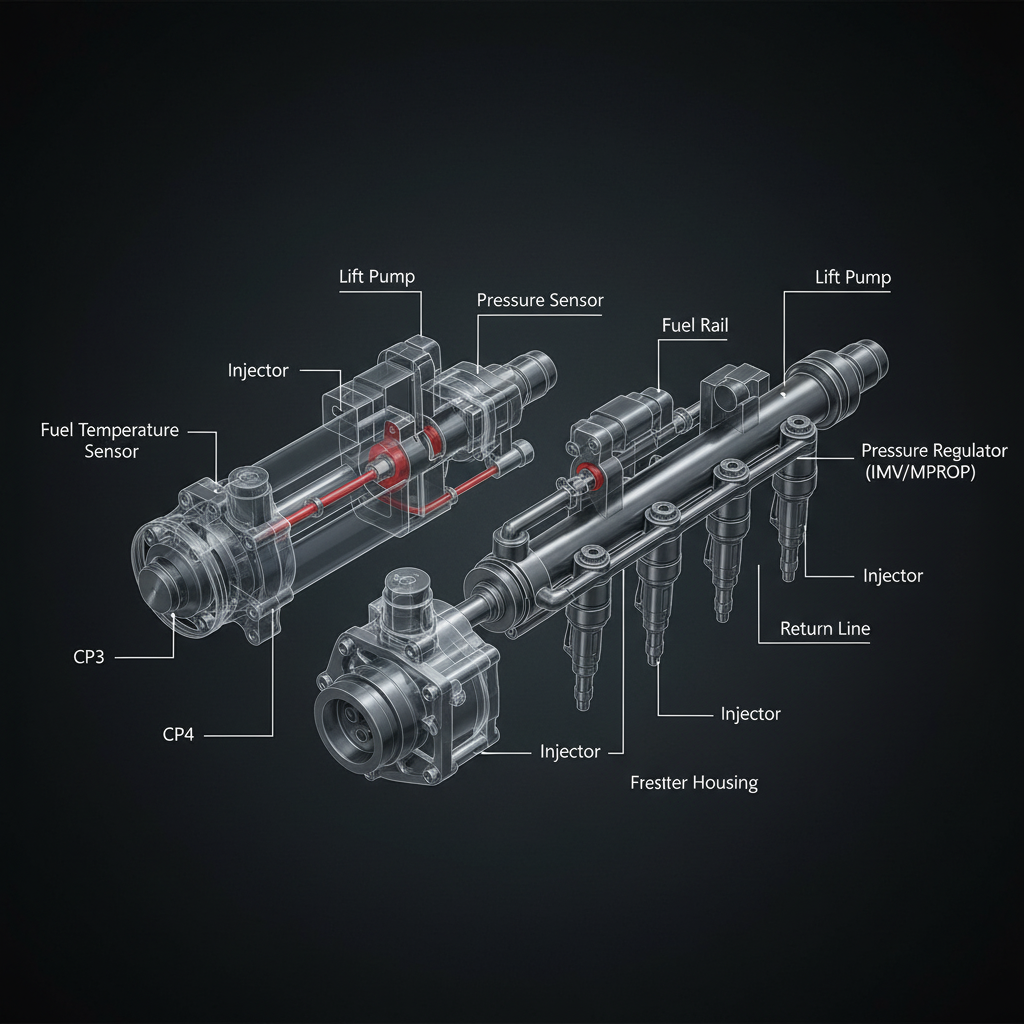
SPN 633 FMI 5 indicates the fuel injection control valve circuit is open or drawing insufficient current — an open/low-current class fault on the inlet metering valve (IMV), fuel control actuator (FCA), or equivalent rail control valve. Open connector, broken wire, failed valve coil, and poor ECM driver connection are the primary causes. Hard start or no-start after the valve connector is not fully locked during pump service is the most documented pattern. Replacing the pump assembly before proving the control valve circuit is the most common misdiagnosis.
Engine & Platform Coverage
Possible Causes
- 1.Open connector — valve connector not fully locked after pump or filter service
- 2.Broken wire in control valve harness from heat or vibration damage
- 3.Failed valve coil — open internal winding
- 4.Poor ECM driver connection at ECM connector
- 5.Corroded or backed-out terminal at valve connector
Wiring & Circuit Notes
Inspect the control valve connector at the pump or rail assembly — heat and vibration damage are common at this location. Verify connector is fully locked. Check for broken wires in the harness run from ECM to valve. Inspect ECM connector for backed-out or corroded terminals on the driver circuit.
DVOM Specs & Sensor Tests
Measure coil resistance against OEM specification — an open coil will read infinite resistance. Verify continuity from ECM driver pin to valve connector. Confirm no short to ground or power before retesting. Avoid repeated actuation commands into an open circuit. After circuit is proven clean, verify command response — the valve should respond to commanded changes in rail pressure.
Diagnostic Flow — FSM Sequence
AI Diesel Tech enforces this evidence-gate sequence. Each gate must pass before advancing.
5 steps locked behind Technician Mode- 1Visually inspect control valve connector — confirm fully locked and no terminal damage
- 2Measure coil resistance at valve connector against OEM specification
- 3Verify continuity from ECM driver pin through harness to valve connector
- 4Confirm no short to ground or power on control circuit with valve disconnected
- 5Reconnect and verify command response — monitor rail pressure vs commanded target
- 6Replace control valve only if electrical circuit is proven clean and command response fails
Unlock the full evidence-gated diagnostic sequence, DVOM test steps, and repair procedures in Technician Mode.
Repair Steps
4 steps locked- 1Visually inspect control valve connector — confirm fully locked and no terminal damage
- 2Measure coil resistance at valve connector against OEM specification
- 3Verify continuity from ECM driver pin through harness to valve connector
- 4Confirm no short to ground or power on control circuit with valve disconnected
- 5Reconnect and verify command response — monitor rail pressure vs commanded target
- 6Replace control valve only if electrical circuit is proven clean and command response fails
Unlock full diagnostic steps, DVOM tests, and repair procedures.
Full Diagnostic Access
Verification steps, preventative measures, severity guidance, and legacy comparison are available in Technician Mode.
Start Diagnosing This Fault Now
AI Diesel Tech walks you through every evidence gate in the correct order. Choose the plan that fits your shop.
Related Resources
Related Systems
Related Fault Codes
Related Sensor Locations
AI Diesel Tech — The Technician's Diagnostic Engine
AI Diesel Tech diagnostic logic is built by an ASE Certified Diesel Technician and engineered for professional shop use. Trusted by technicians nationwide — used in shops, fleets, and training programs.
Summary
SPN 633 FMI 5 is an electrical open-circuit diagnosis at the fuel control valve. Coil resistance, continuity, and connector integrity must be proven before the valve or pump assembly is condemned.