
Fuel Aeration and Suction-Side Leak Isolation
Aeration is a suction-side integrity problem and a top cause of mystery fuel-pressure loss. Post-filter-service aeration and intermittent under-load starvation with return to normal at idle are the most documented patterns. The FSM enforces suction-side sequence before HP pump condemnation.
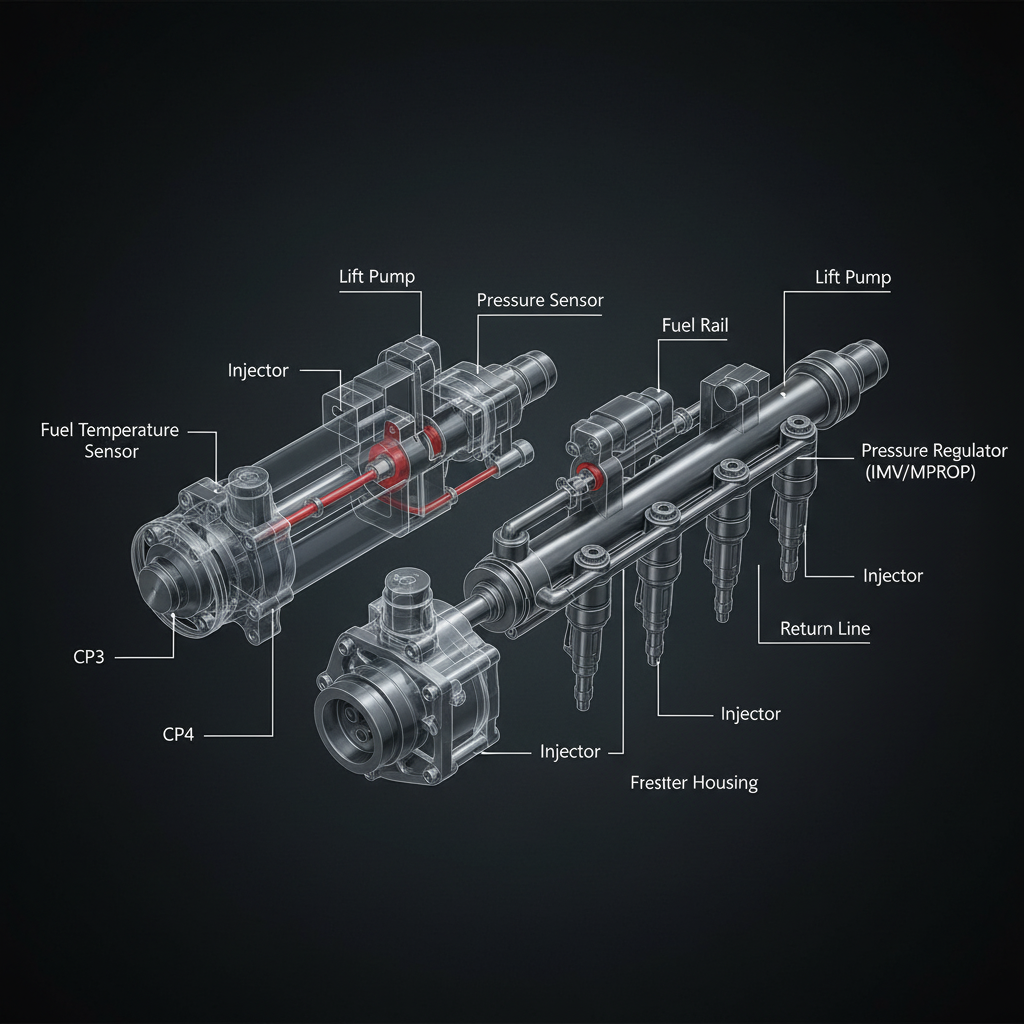
Fault Overview
Fuel aeration and suction-side leaks produce low rail pressure and hard-start complaints that are identical to HP pump failure symptoms. Loose filter seals, cracked quick-connects, porous lines, failing O-rings, dry tanks, and poor primer seals are the primary causes. Post-filter-service aeration and intermittent under-load starvation with return to normal at idle are documented patterns. Air intrusion on the suction side allows air to enter the fuel system and reduces the effective fuel supply to the HP pump — the HP pump cannot maintain rail pressure when air is present in the supply.
Engine & Platform Coverage
Symptoms
- •Air in fuel diesel
- •Suction side fuel leak
- •Hard start after filter change
- •Fuel bubbles in lines
- •Aerated fuel under load
- •Low rail pressure from aeration
Possible Causes
- 1.Loose filter seals — filter seal not properly seated producing air intrusion
- 2.Cracked quick-connects — cracked quick-connect fitting allowing air intrusion
- 3.Porous lines — porous or cracked fuel line allowing air intrusion
- 4.Failing O-rings — O-ring failure at fittings allowing air intrusion
- 5.Dry tanks — tank run-out allowing air into the suction path
- 6.Poor primer seals — primer pump seal failure allowing air intrusion
Diagnostic Flow — FSM Sequence
AI Diesel Tech enforces this evidence-gate sequence. Each gate must pass before advancing.
6 steps locked behind Technician Mode- 1Step 1 — Verify Filter Install and Seals: Verify the filter installation and seals after any filter service. Post-filter-service aeration is a documented pattern. Confirm the filter is correctly installed and the seals are properly seated. A filter seal that is not properly seated allows air to enter the fuel system on the suction side.
- 2Step 2 — Inspect Suction Fittings: Inspect suction fittings for cracks and air intrusion. Cracked quick-connects and failing O-rings at suction fittings allow air to enter the fuel system. Inspect all suction-side fittings from the tank to the lift pump for cracks, damage, and proper seating.
- 3Step 3 — Pressure and Volume Test at Idle and Load: Perform a pressure and volume test at idle and under load. Intermittent under-load starvation with return to normal at idle is a documented pattern. A supply pressure that collapses under load confirms a suction-side restriction or aeration fault. Use clear lines or a sight glass where safe and OEM-approved to observe aeration.
- 4Step 4 — Isolate Section by Section: Isolate the suction-side fault section by section. Disconnect and cap sections of the suction path to identify the section where air intrusion occurs. A section that eliminates the aeration when isolated confirms the air intrusion source.
- 5Step 5 — Repair Leak Path and Re-Prime: Repair the identified leak path and re-prime the fuel system. A suction-side repair that is not followed by proper re-priming leaves air in the system that produces hard start and low rail pressure until the air is purged. Re-prime per OEM procedure after any suction-side repair.
- 6Step 6 — Validate Pressure Sensor Integrity: Validate pressure sensor integrity so aeration is not confused with sensor noise. A pressure sensor fault producing erratic rail pressure readings can be misidentified as aeration. Confirm pressure sensor integrity before concluding aeration is the cause of erratic rail pressure.
- 7Step 7 — HP Pump Decision Only After Suction-Side Proof: Make the HP pump decision only after suction-side proof. A suction-side fault that is not corrected before HP pump replacement produces HP pump failure from aeration. Confirm suction-side integrity before any HP pump diagnosis or replacement.
Unlock the full evidence-gated diagnostic sequence, DVOM test steps, and repair procedures in Technician Mode.
Repair Steps
3 steps locked- 1Repair or replace loose filter seals.
- 2Replace cracked quick-connects or failing O-rings.
- 3Replace porous or cracked fuel lines.
- 4Service primer pump if seal failure is confirmed.
- 5Re-prime fuel system per OEM procedure after any suction-side repair.
Unlock full diagnostic steps, DVOM tests, and repair procedures.
Full Diagnostic Access
Verification steps, preventative measures, severity guidance, and legacy comparison are available in Technician Mode.
Start Diagnosing This Fault Now
AI Diesel Tech walks you through every evidence gate in the correct order. Choose the plan that fits your shop.
Related Resources
Related Fault Codes
Related Systems
Related Sensor Locations
Common Symptoms
Related Articles
AI Diesel Tech — The Technician's Diagnostic Engine
AI Diesel Tech diagnostic logic is built by an ASE Certified Diesel Technician and engineered for professional shop use. Trusted by technicians nationwide — used in shops, fleets, and training programs.
Summary
Aeration is a suction-side integrity problem and a top cause of mystery fuel-pressure loss. The AI Diesel Tech FSM enforces suction-side sequence before HP pump condemnation.