
Injector Stiction Diagnosis
Injector Stiction
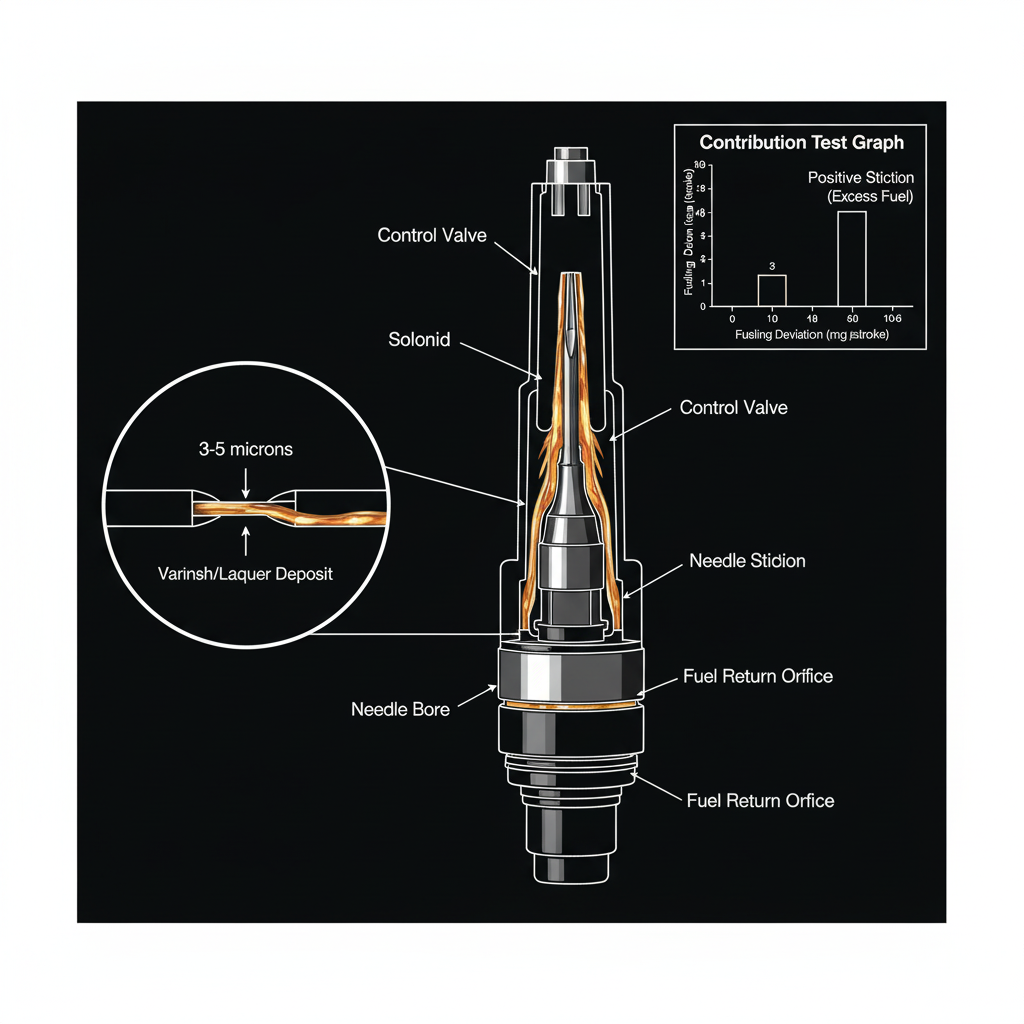
Injector stiction is a subtle but powerful diesel failure mode where injectors respond slowly or inconsistently, especially when cold. It causes hard starts, rough idle, misfires, and increased soot. This guide helps you separate stiction from pure electrical or hydraulic failure.
Why This Matters
- ▸ Stiction causes cold-start complaints and rough idle — test balance rates before replacing injectors.
- ▸ Slow injectors increase soot and fuel consumption across all cylinders.
- ▸ Misdiagnosed stiction leads to unnecessary full injector replacement.
- ▸ Fleets lose reliability when stiction is ignored or treated as a minor issue.
8-Step Diagnostic Flow
Gather symptom history
Determine whether symptoms occur cold vs hot, intermittently vs constantly, and under what conditions. Stiction is typically worse when cold and improves as the engine warms up. A symptom that only appears at cold start and clears after warmup is a classic stiction pattern.
Check balance rates at cold idle and warm idle
Balance rates show how much fuel each injector is adding or subtracting to maintain smooth idle. At cold idle, stiction causes high positive balance rates (injector adding extra fuel to compensate for slow response). Compare cold vs warm balance rates — improvement with warmup confirms stiction.
Perform cylinder cut-out tests and note response time
Cut out each cylinder individually and note the RPM drop. A cylinder with a sticking injector will show a smaller RPM drop than healthy cylinders, especially when cold. Slow response time during cut-out is a key indicator of stiction.
Check fuel quality and contamination history
Poor fuel quality, water contamination, and low lubricity fuel accelerate injector stiction. Review fuel quality history and inspect the filter element for contamination. Contaminated fuel that has been running through the system may have already caused damage.
Inspect for oil or fuel additives used to address stiction
Some operators use oil or fuel additives to address stiction. While some products can help, they are not a cure-all and can mask underlying problems. Document any additives used — this affects the diagnosis and repair decision.
Check rail pressure stability during cold operation
SPN 157 (fuel rail pressure). Stiction can cause rail pressure instability during cold operation as the ECM compensates for slow injector response. Watch for pressure oscillation at cold idle that stabilizes as the engine warms up.
Compare injector performance across cylinders
Use balance rates and cylinder contribution data to identify which cylinders are affected. Stiction often affects multiple injectors to varying degrees. A single severely affected cylinder with others normal suggests a mechanical issue rather than stiction.
Decide between cleaning, conditioning, or replacement
Based on severity and data, determine the appropriate repair. Mild stiction with good balance rates may respond to cleaning or conditioning. Severe stiction with large balance rate swings and poor cylinder contribution requires injector replacement.
Engine-Specific Notes
Cummins ISX / X15
Certain Cummins platforms are more prone to cold stiction, especially in low-temperature climates. Watch for balance rate swings during warm-up that stabilize after 10–15 minutes of operation. Cummins recommends specific fuel lubricity additives in cold climates.
Detroit DD13 / DD15
High-mileage Detroit injectors may show slow response before outright failure. Fuel quality and filtration are critical — Detroit's common rail injectors are sensitive to contamination. Monitor balance rates closely in fleets with variable fuel quality.
Paccar MX-13
Stiction on MX-13 often appears in severe-duty or stop-and-go fleets where injectors cycle frequently at low temperatures. Monitor cold-start behavior closely. MX-13 injectors in high-idle applications are less prone to stiction due to sustained operation.
Volvo / Mack MP8
EGR and airflow issues can mask injector stiction on Volvo platforms — always consider the whole combustion picture. A rough idle that persists after EGR and airflow verification points to injector issues. Volvo balance rate data is reliable for stiction diagnosis.
CAT C13 / C15
HEUI and similar systems historically showed stiction behavior on CAT engines. Oil quality and maintenance intervals matter — degraded oil increases stiction risk. CAT recommends specific oil viscosity grades for cold-climate operation to reduce stiction.
International A26
Stiction on A26 can coexist with electrical harness issues — separate mechanical from electrical with proper testing. A26 injectors in vocational applications with frequent cold starts are more prone to stiction than highway applications.
DVOM Test Points
| Test | Spec | Note |
|---|---|---|
| Injector solenoid resistance | Within OEM spec (typically 0.5–2.0 Ω) | Out-of-spec resistance = electrical failure, not stiction |
| Harness integrity | Continuity and insulation resistance per OEM spec | Verify electrical integrity before attributing issues to mechanical stiction |
| Voltage supply | Proper injector drive voltage at ECM output | Low drive voltage causes slow response that mimics stiction |
Live Data Parameters to Monitor
Balance Rates (cold vs warm)
High positive rates cold, normalizing warm = stiction pattern
Cylinder Contribution
Low contribution on affected cylinders, especially cold
Rail Pressure Stability
Oscillation at cold idle that stabilizes warm = stiction compensation
Injection Quantity Per Cylinder
Compare across cylinders — outliers indicate stiction or failure
Related Fault Codes
Frequently Asked Questions
Is stiction the same as a bad injector?
Not exactly. Stiction is a slow or sticky mechanical response that may be improved with cleaning or conditioning. A bad injector has failed electrically or mechanically and cannot be restored. Data should guide whether conditioning or replacement is appropriate.
Can additives fix stiction?
Some products can help with mild stiction by improving fuel lubricity and cleaning deposits. However, they are not a cure-all. Severe stiction with large balance rate swings and poor cylinder contribution requires injector replacement regardless of additives used.
Why is stiction worse when cold?
Oil and fuel viscosity, clearances, and deposits all behave differently at low temperatures. Cold oil is thicker and provides more resistance to injector movement. Deposits that are soft when hot become harder when cold, increasing the force required to open the injector.
Master Injector Diagnosis
The AI Diesel Tech Academy covers injector balance rates, stiction testing, cylinder contribution analysis, and fuel system diagnostics with real-world case studies.
Explore the Academy