
No-Start Diagnosis
Diesel Won't Start
A diesel that won't start is one of the most urgent breakdowns in the world. Whether you're in the USA, Canada, Australia, UK, South Africa, India, or running long-haul across global corridors, this guide delivers technician-grade diagnostics built on American diesel standards and trusted worldwide.
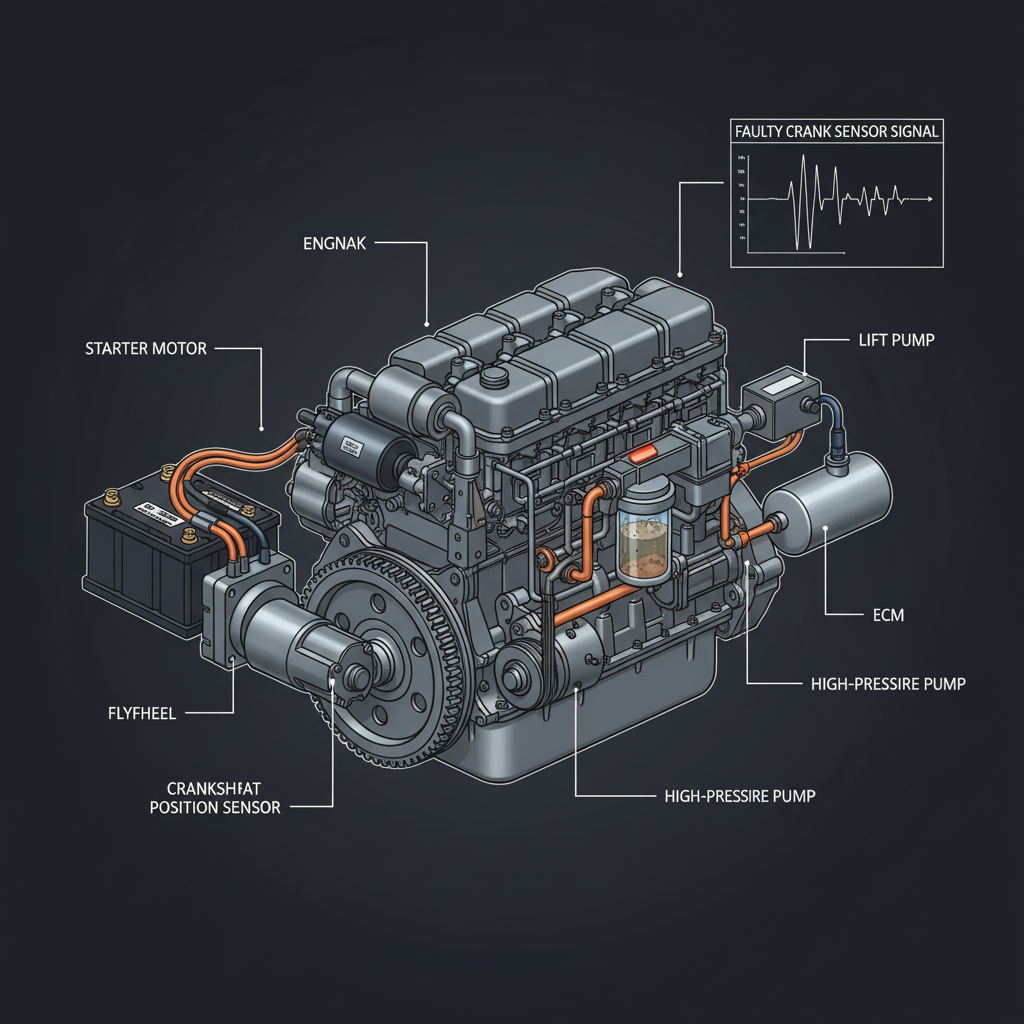
Why This Matters
- ▸ Truck down. Load delayed. Fleet losing money by the hour.
- ▸ No-start failures cost fleets thousands per hour in downtime and towing.
- ▸ Misdiagnosis leads to unnecessary injector or pump replacement — $3,000–$8,000 wasted.
- ▸ Built on USA diesel diagnostic standards with global engine coverage.
No-Start Diagnostic Flow
Verify cranking speed
Minimum RPM threshold varies by engine family. Cummins ISX/X15: ≥150 RPM. Detroit DD: ≥100 RPM. Low crank = battery/starter/ground issue before fuel diagnosis.
Check fuel rail pressure (FRP)
Crank FRP should reach 5,000–15,000 PSI depending on engine. No pressure = lift pump, check valve, or high-pressure pump failure.
Check injection control pressure (ICP)
Applies to HEUI engines (International, Ford 6.0/6.4/7.3). ICP must reach 500+ PSI to enable injection.
Check cam/crank sync
SPN 636 (cam) or SPN 723 (crank) faults prevent injection enable. Verify signal with DVOM or scope.
Check low-pressure fuel supply
Lift pump output: 5–15 PSI at idle. Restriction at filter, pickup tube, or check valve causes no-start.
Check high-pressure pump output
If lift pump is good but FRP won't build, suspect HP pump wear, timing, or internal bypass.
Check injector enable logic
ECM must see valid RPM, cam/crank sync, and no active shutdown faults before enabling injectors.
Check ECM power and grounds
SPN 168 (battery voltage) faults or poor grounds prevent ECM from commanding injection. Test with DVOM.
Engine-Specific No-Start Patterns
Cummins ISX / X15
Common no-start: SPN 157 (FRP low), SPN 636/723 (cam/crank), SPN 168 (voltage). Check HPCR pump and lift pump before condemning injectors.
Detroit DD13 / DD15 / DD16
Common no-start: SPN 157, SPN 636, SPN 609/629 (ECM). Detroit requires cam sync before any injection event.
Paccar MX-13 / MX-11
Common no-start: SPN 157, SPN 636, SPN 723. MX engines are sensitive to fuel aeration — check for air intrusion on suction side.
Volvo / Mack MP8
Common no-start: SPN 157, SPN 636. Volvo D13 uses a separate lift pump relay — verify relay and fuse before fuel pressure testing.
CAT C7 / C9 / C13 / C15
HEUI-based engines require ICP. Common no-start: ICP sensor, IPR valve, oil aeration. Check oil level and condition first.
International A26 / MaxxForce
HEUI architecture. Common no-start: ICP, IPR, SPN 636/723. MaxxForce EGR oil contamination can cause no-start via oil aeration.
DVOM Testing Block
| Test | Spec | Note |
|---|---|---|
| Injector solenoid resistance | 0.5–2.0 Ω (varies by engine) | Open or shorted solenoid prevents injection on that cylinder |
| Cam/crank sensor resistance | 900–1,200 Ω (magnetic pickup) | Out-of-spec resistance = weak or missing signal |
| Fuel pump voltage supply | 12–14V key-on | Low voltage = relay, fuse, or wiring fault before condemning pump |
| ECM power/ground integrity | <0.1V drop on ground circuits | High resistance grounds cause intermittent no-start and false codes |
Live Data Parameters to Monitor
FRP (Fuel Rail Pressure)
5,000–15,000 PSI cranking
ICP (Injection Control Pressure)
≥500 PSI cranking (HEUI only)
RPM
≥100–150 RPM cranking
Cam/Crank Sync State
Synced = 1 or "Yes"
Injection Quantity
Should show commanded value when cranking
Fuel Temperature
<140°F — high temp reduces density
Rail Pressure Desired vs Actual
Desired should match actual within 500 PSI
Related Fault Codes
Frequently Asked Questions
Diesel cranks but won't fire?
Most common causes: no fuel rail pressure (lift pump or HP pump failure), cam/crank sync fault (SPN 636/723), or ECM not enabling injection due to a shutdown fault. Start with FRP during crank — if it doesn't build, the fuel system is the root cause.
No crank at all?
No-crank is a starting circuit issue, not a fuel issue. Check battery voltage (should be ≥12.4V), starter relay, neutral safety switch, and clutch switch. Use DVOM to verify voltage at the starter solenoid during key-crank.
Starts then immediately dies?
Common causes: low fuel supply pressure dropping off after initial prime, active shutdown fault (oil pressure, coolant temp, or aftertreatment), or ECM losing cam/crank sync after initial fire. Check for active faults and monitor FRP during the brief run period.
Learn DVOM Testing for No-Start Failures
The DVOM & Multimeter Fundamentals course covers every test in this guide — cam/crank sensors, fuel pump circuits, ECM grounds, and injector solenoids.
View DVOM Course