
Derate Recovery
Diesel Derated — Won't Go Over 5 MPH
A derated truck stuck at 5 MPH is a global emergency. This USA-built diagnostic guide covers aftertreatment inducement stages, DEF quality, SCR efficiency, and derate recovery for all major engine families worldwide.
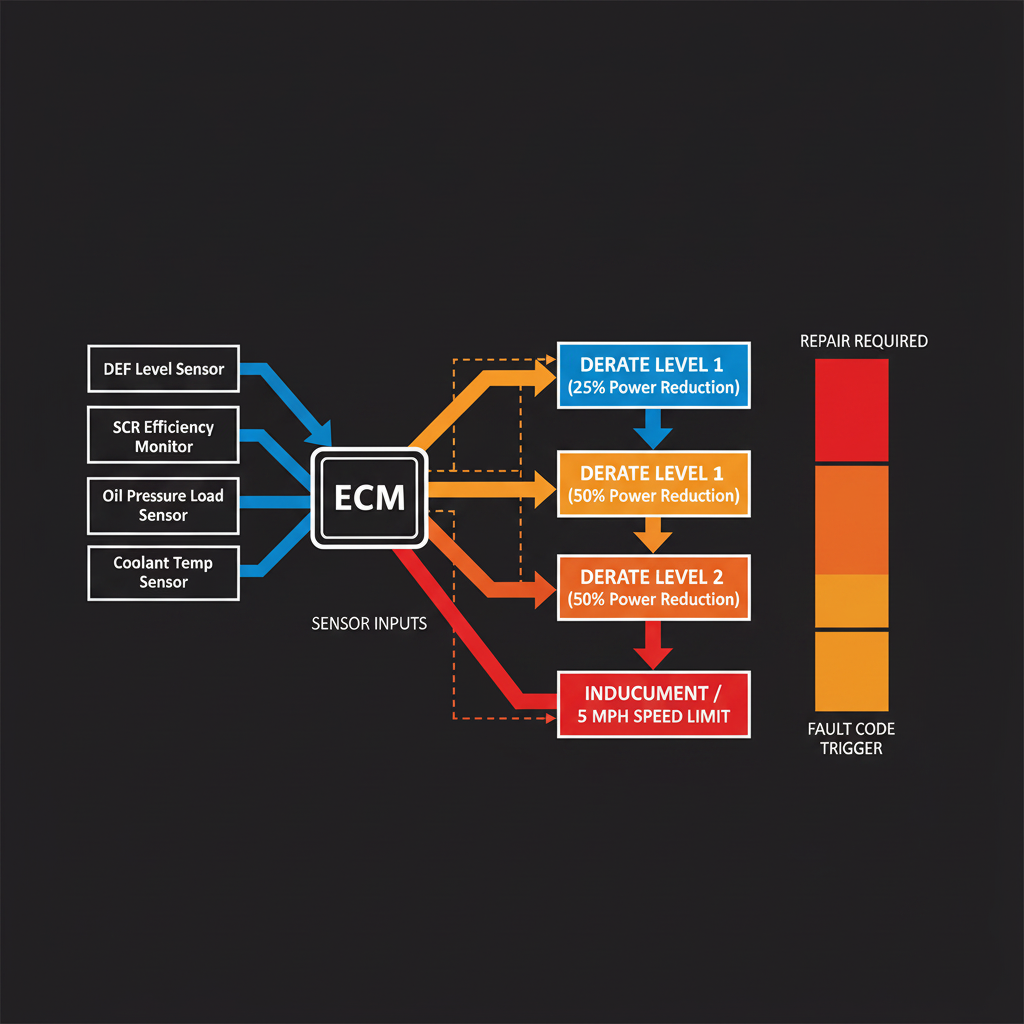
Why This Matters
- ▸ Fleet shutdown. Delivery missed. Driver stranded on the highway.
- ▸ Derate = forced protection mode — the ECM is commanding the limit, not a sensor glitch.
- ▸ Clearing codes without fixing the root cause will not remove the 5 MPH limit.
- ▸ Misdiagnosis leads to unnecessary SCR catalyst replacement — $4,000–$12,000 wasted.
Derate Recovery Diagnostic Flow
Identify derate level
5 MPH = severe inducement (Stage 3/4). 20% or 40% power reduction = earlier stages. Identify the stage before chasing individual faults.
Check aftertreatment faults
Pull all active and inactive faults. SCR efficiency (SPN 4364), DEF quality (SPN 3364/5246), and DPF soot (SPN 3031) are the most common 5 MPH triggers.
Check DEF quality
Contaminated or diluted DEF (below 32.5% urea) triggers SPN 5246 FMI 31. Test with a refractometer — spec is 32.5% ±1.5%.
Check SCR efficiency
SPN 4364 FMI 18 = SCR efficiency below threshold. Caused by DEF quality, dosing failure, or SCR catalyst degradation. Monitor NOx in vs NOx out.
Check NOx sensors
Biased or failed NOx sensors cause false SCR efficiency faults. Compare inlet vs outlet NOx at steady cruise. Inlet should be 3–10x outlet.
Check DPF soot/ash levels
SPN 3031 FMI 0 (soot high) can contribute to derate. Check differential pressure and regen history before condemning the DPF.
Check regen history
Frequent aborted regens or long intervals between regens indicate a regen system problem, not just a full DPF.
Check fuel system contribution
Low fuel rail pressure can cause incomplete regen (insufficient post-injection fuel for DOC light-off), leading to DPF soot accumulation and eventual derate.
Engine-Specific Derate Patterns
Cummins X15
Inducement cascade: SPN 4364 → SPN 5246 → 5 MPH. Check DEF quality first. X15 uses a 4-stage inducement — identify the stage from active faults before replacing parts.
Detroit DD15
Common 5 MPH trigger: SPN 3364 (DEF quality) or SPN 4364 (SCR efficiency). Detroit's inducement counter resets only after verified SCR efficiency recovery — not just fault clearing.
Paccar MX-13
MX engines are sensitive to NOx sensor bias. A biased upstream NOx sensor causes false SCR efficiency faults. Compare sensor readings before condemning the SCR catalyst.
Volvo / Mack MP8
Volvo D13 uses a separate DEF dosing module. Check DEF pump pressure (spec: 7–9 bar) and dosing valve operation before diagnosing SCR catalyst efficiency.
CAT C13 / C15
CAT uses a different inducement structure. Check for SPN 3242 (SCR outlet temp) and SPN 3246 (SCR inlet temp) faults that indicate catalyst or dosing issues.
International A26
A26 shares Cummins aftertreatment architecture. Follow Cummins X15 inducement logic. Check DEF quality and SCR efficiency before any catalyst replacement.
DVOM Testing Block
| Test | Spec | Note |
|---|---|---|
| NOx sensor circuits | 12–14V supply, <0.5V ground | Voltage drop on supply or ground causes sensor bias and false SCR efficiency faults |
| DEF pump voltage | 12–14V at pump connector | Low voltage = relay, fuse, or wiring fault — not a pump failure |
| DPF pressure sensor | 0.5–4.5V signal range | Stuck high = false soot load reading; stuck low = no regen trigger |
| SCR temp sensors | 0.5–4.5V signal range | Out-of-range temp sensors cause false SCR efficiency and dosing faults |
Live Data Parameters to Monitor
DEF Quality (%)
32.5% ±1.5% urea concentration
SCR Efficiency (%)
≥70% at steady cruise (engine-dependent)
NOx Conversion (%)
Outlet NOx should be 70–95% lower than inlet
DPF Differential Pressure
Engine-specific; high = soot load or restriction
Soot Load (%)
<80% for normal operation; >100% = regen required
Ash Load (%)
>100% = DPF service required (cleaning or replacement)
Related Fault Codes
Frequently Asked Questions
Why is my truck stuck at 5 MPH?
5 MPH is Stage 3 or 4 aftertreatment inducement — the ECM has detected a severe emissions system failure and is forcing a speed limit to compel repair. The most common causes are DEF quality below spec, SCR efficiency failure, or a DEF dosing system fault. Clearing codes without fixing the root cause will not remove the 5 MPH limit.
Can I clear the 5 MPH derate without fixing the SCR?
No. The inducement counter is stored in the ECM and requires verified SCR efficiency recovery to reset. Simply clearing fault codes will not remove the derate — the system must see acceptable NOx conversion at operating temperature before the counter resets.
How do I know if it's DEF quality or SCR catalyst failure?
Test DEF concentration with a refractometer first (spec: 32.5% ±1.5%). If DEF is good, monitor NOx inlet vs outlet at steady cruise. If NOx conversion is below 70%, the SCR catalyst may be degraded. Also check NOx sensor accuracy — a biased sensor can cause false efficiency faults without actual catalyst failure.
Learn Aftertreatment Sensor Testing
The DVOM & Multimeter Fundamentals course covers NOx sensor circuits, DEF pump testing, and SCR temp sensor diagnosis.
View DVOM Course